REV 27-0032
Waste vegetable oil used to make biodiesel for personal use
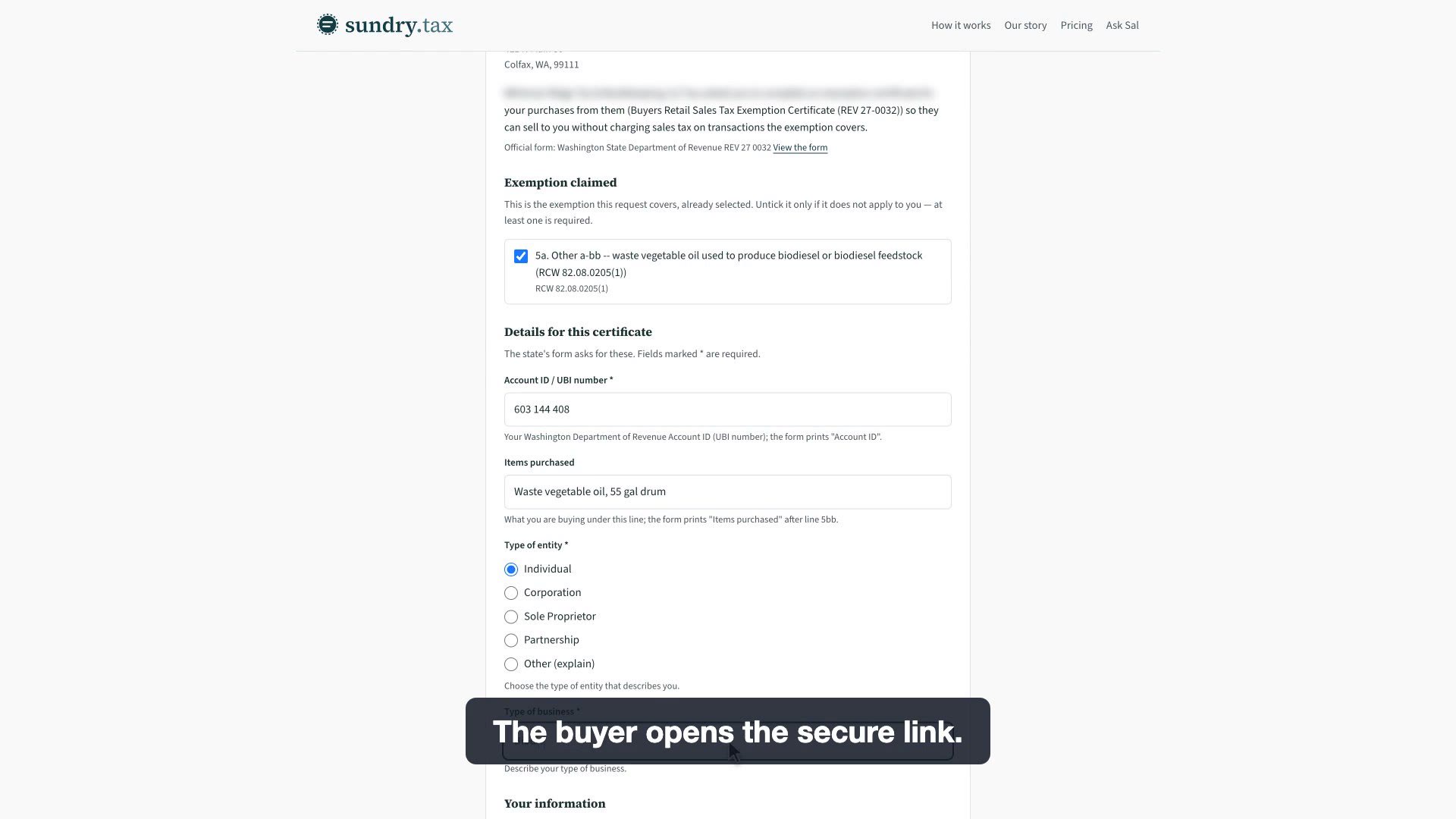
A firm asks a customer for this certificate, the buyer fills in and signs the form from the emailed link, and Sundry shows it signed and Verified by Sundry.
A person who turns used cooking oil into biodiesel for their own use pays no Washington sales or use tax on the oil bought from restaurants or commercial food processors. The test is that the buyer does not sell biodiesel at all: anyone in the business of selling it, at wholesale or retail, does not qualify.
Who qualifies
- A person who uses the oil to produce biodiesel for "personal use."
- "Personal use" means the person does not engage in the business of selling biodiesel at wholesale or retail.
What qualifies
- "Waste vegetable oil": used cooking oil gathered from restaurants or commercial food processors.
- The oil must be used in the production of biodiesel.
Not covered
- Oil bought by anyone in the business of selling biodiesel at wholesale or retail.
- Oil that is not used cooking oil from a restaurant or commercial food processor, such as new vegetable oil.
- Other inputs and equipment for making biodiesel. The statute exempts only the waste vegetable oil.
- Oil bought to resell. Form REV 27 0032 says it is not for resale purchases.
What the buyer gives
Form REV 27 0032 (revision 6/17/25), line 5a: "Waste vegetable oil used to produce biodiesel fuel for personal use." The instructions say 5a applies to purchases "from restaurants and food processors" and "does not apply to persons that are engaged in selling biodiesel fuel at wholesale or retail." The buyer ticks single use or blanket (useful for regular pickups from the same restaurant), enters the seller's name and address and the date, checks 5a, and completes the certification block (type of entity, type of business, Account ID, name, title, address, signature). RCW 82.08.0205(2): the exemption "is available only if the buyer provides the seller with an exemption certificate in a form and manner prescribed by the department."
What the seller keeps
The seller here is usually the restaurant or food processor selling its used oil, and it keeps the certificate. Form REV 27 0032 says: "Seller must retain the original of this certificate for their records. Do not send a copy of this certificate to the Department of Revenue." RCW 82.32.070(1) requires taxpayers to "keep and preserve, for a period of five years, suitable records as may be necessary to determine the amount of any tax for which the taxpayer may be liable." Under RCW 82.08.050(4) a seller is not relieved of the tax unless it keeps proper records of exempt sales and provides them when asked; (7)(a) relieves a seller that obtains a fully completed certificate within 90 days after the sale, and (7)(b) allows 120 days after a department request to prove the sale was not taxable or obtain a fully completed certificate taken in good faith.
Common mistakes
- A small biodiesel seller claiming the exemption. Any business of selling biodiesel, wholesale or retail, rules it out.
- A restaurant handing over oil for a price without a certificate. Without the certificate the exemption is not available.
- Using the certificate for fresh oil or other feedstock. Only used cooking oil from restaurants or commercial food processors qualifies.
Common questions
- Does a restaurant charge sales tax when it sells used fryer oil to someone making their own biodiesel?
- Not if the buyer makes biodiesel for personal use, is not in the business of selling biodiesel, and gives the restaurant a completed REV 27 0032 with line 5a checked.
- What if I sell a little of the biodiesel I make?
- Then it is not "personal use" if you are engaged in the business of selling biodiesel at wholesale or retail, and the exemption does not apply.
- Is there use tax on oil I collect for free?
- RCW 82.12.0205 exempts the use of waste vegetable oil used to produce biodiesel for personal use, on the same definitions.
Sources
- RCW 82.08.0205 (1)-(3) exemption, certificate and definitions
- RCW 82.12.0205 Matching use tax exemption
- DOR form REV 27 0032 (6/17/25), Buyer's Retail Sales Tax Exemption Certificate Page 3 line 5a; page 4 certification; page 6 line 5a instructions
- RCW 82.08.050 (4), (7)(a)-(c) seller records and certificate timing
- RCW 82.32.070 (1) five-year record retention
- Form
- REV 27-0032: Buyers Retail Sales Tax Exemption Certificate
- Statute
- RCW 82.08.0205(1)
- Category
- Use
- How the buyer provides it
- Signs the state form in the buyer portal