REV 36-0001
Retail sale to a tribal member for delivery in the tribe's Indian country
A firm asks a customer for proof of tribal membership, the buyer uploads a photo of their tribal ID from the emailed link, and Sundry shows it received and checked.
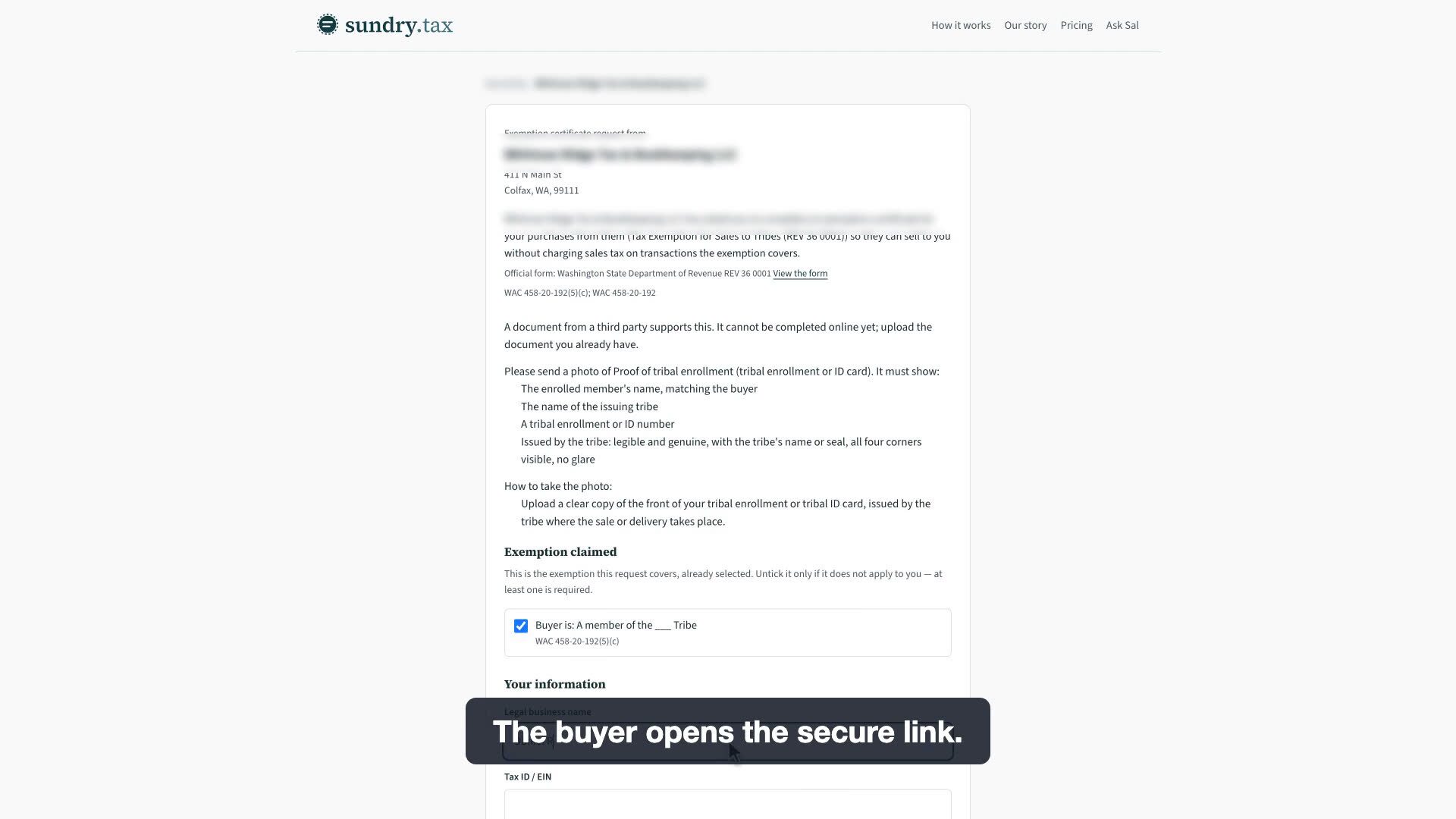
Washington does not tax enrolled tribal members in their own tribe's Indian country. A sale of goods to a member is free of sales tax when the goods are delivered to the member in that tribe's Indian country or the sale takes place there; a retail service is free of sales tax when it is performed there. The seller keeps DOR form REV 36 0001 and the proof of membership it saw.
Who qualifies
- A person on the tribal rolls of an Indian tribe (an enrolled member), buying in the Indian country of the tribe they are enrolled in. Members of other tribes do not count for this purpose.
- An enrolled member's spouse, if this treatment does not conflict with tribal law. Form REV 36 0001 has a box for "A spouse of a member of the Tribe."
- "Indian country" means land within a reservation (including rights of way), dependent Indian communities, and Indian allotments whose Indian titles have not been extinguished.
What qualifies
- Goods delivered to the member in Indian country, or sold at a store located in Indian country (there is then no need to show delivery).
- Retail services performed for the member in Indian country, such as construction. Where a service is performed both on and off Indian country, only the part done in Indian country is excluded.
- Use tax does not apply when a member acquires goods in Indian country for at least partial use there.
- Form REV 36 0001 also covers refuse tax, public utility tax and telephone or 911 taxes on services the seller provides to the buyer in their Indian country.
Not covered
- Goods the member takes delivery of outside Indian country.
- Services, or the part of a service, performed outside Indian country, such as the off-reservation stretch of a road job.
- Sales to nonmembers, including members of a different tribe, even when delivered in Indian country.
- Vehicles, and treaty fishing, hunting and gathering purchases. DOR lists separate forms for these on page 2 of REV 36 0001.
- A member's business buying inventory for resale. DOR says such a business that operates only in its Indian country may use a state or tribal reseller permit or the Streamlined Sales and Use Tax Certificate of Exemption.
What the buyer gives
Proof of membership: a tribal member card, certificate of membership, or treaty fishing identification card (form REV 36 0001). WAC 458-20-192(5)(c): "unless the purchaser is personally known to the seller as a member, the seller must require presentation of a tribal membership card or other suitable identification." A spouse shows proof of the relationship and of the spouse's membership. Form REV 36 0001 is completed by the seller, not signed by the buyer: the seller enters its name and UBI, the buyer's name, the delivery address in Indian country, ticks who the buyer is and which proof was shown, then the date of sale and amount for the retail sales tax box.
What the seller keeps
Form REV 36 0001: "The buyer must show you proof that they meet the exemption criteria below. You must keep this form as proof that they meet the exemption criteria below." WAC 458-20-192(4): taxpayers "are required to maintain appropriate records on the tax exempt status of transactions." Keep the delivery record too; the exemption turns on delivery in, or a sale in, Indian country. Check whether an address is in Indian country with DOR's sales tax rate lookup, which shows "Indian Country" and the tribe's name (REV 36 0001 page 2). RCW 82.32.070(1) requires five years of records. Separately, WAC 458-20-192(7)(b) says the seller's own B&O tax may not apply to goods delivered to the member in Indian country if the goods were in Indian country at sale, the seller has a place of business there that took the order or distributed the goods, or the seller solicited the sale while in Indian country.
Common mistakes
- Exempting a member of a different tribe. The rule covers only people enrolled with the tribe whose territory the activity is in.
- Exempting a member who takes the goods at an off-reservation counter. Without delivery in Indian country, or a sale there, sales tax applies.
- Keeping no record of the ID. The seller must see a membership card or other suitable ID unless it personally knows the buyer is a member, and should note which proof it saw on REV 36 0001.
- Exempting the whole of a job that runs off the reservation. Only the work done in Indian country is excluded.
Common questions
- Do I charge Washington sales tax to a tribal member if I deliver to their reservation?
- No, if the buyer is enrolled in the tribe whose Indian country the delivery is in. WAC 458-20-192(5)(a) says sales tax is not imposed when goods are delivered to the member in Indian country. Keep form REV 36 0001 and note the proof of membership.
- Does the buyer have to sign form REV 36 0001?
- The form has no buyer signature line. The seller fills it in, records the proof the buyer showed, and keeps it.
- Is a tribal member's spouse exempt too?
- WAC 458-20-192(5) treats an enrolled member's spouse as an Indian for this rule if that does not conflict with tribal law. The spouse shows proof of the relationship and of the member's enrollment.
- How do I know whether an address is in Indian country?
- Look up the delivery address with DOR's sales and use tax rate lookup. If it is in Indian country, the result shows "Indian Country" and the tribe's name (REV 36 0001, page 2).
Sources
- WAC 458-20-192 (2) definitions; (4) recordkeeping; (5), (5)(a)-(c); (7)(b)
- DOR form REV 36 0001 (2/9/23), Tax Exemption for Sales to Tribes Page 1 buyer types and proof; page 2 tax boxes, Indian country lookup, other forms
- RCW 82.32.070 (1) five-year record retention
- Form
- REV 36-0001: Tax Exemption for Sales to Tribes
- Statute
- WAC 458-20-192(5)(c)
- Category
- Entity