REV 27-0032
Trail grooming services bought by the state or a nonprofit
A firm asks a customer for this certificate, the buyer fills in and signs the form from the emailed link, and Sundry shows it signed and Verified by Sundry.
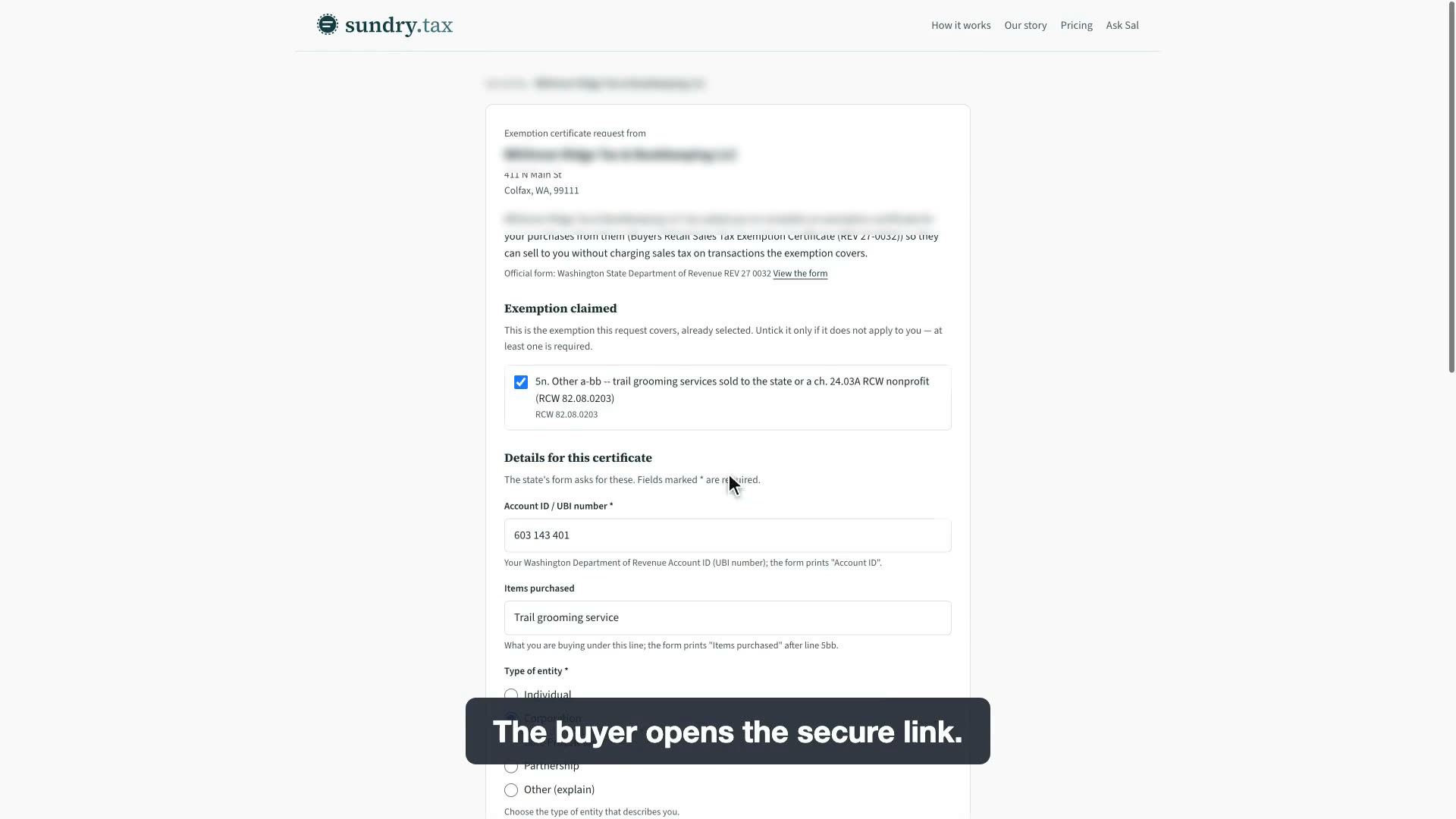
When the State of Washington or a Washington nonprofit corporation pays a contractor to groom snow trails, the contractor does not charge sales tax on the grooming. The exemption covers only the service of compacting, redistributing or removing snow on trails, and only for those two kinds of buyer.
Who qualifies
- The State of Washington.
- A nonprofit corporation organized under chapter 24.03A RCW (the Washington nonprofit corporation act). Other entity types, and nonprofits organized under another state's law, are not named.
- The trails may be state-owned or privately owned.
What qualifies
- Trail grooming services: snow compacting, snow redistribution or snow removal on state-owned or privately owned trails.
Not covered
- Grooming bought by any other buyer. The statute names only the state and nonprofit corporations under chapter 24.03A RCW.
- Goods bought by the state or the nonprofit, such as grooming machines, drags, parts or fuel. The exemption is for sales of trail grooming services.
- Trail work that is not snow compacting, redistribution or removal, such as summer trail maintenance; it falls outside the statutory definition.
What the buyer gives
Form REV 27 0032 (revision 6/17/25), line 5n: "Trail grooming services." The buyer ticks single use or blanket (a season of grooming from one contractor can be covered by a blanket certificate while there is at least one sale within 12 months), enters the contractor's name and address and the date, checks 5n, describes the service under "Items purchased," and completes the certification block (type of entity, type of business, Account ID, name, title, address, signature). The form instructions describe 5n as purchases by the State of Washington and nonprofit corporations, and repeat the snow compacting, redistribution and removal definition.
What the seller keeps
The grooming contractor is the seller and keeps the certificate. Form REV 27 0032 says: "Seller must retain the original of this certificate for their records. Do not send a copy of this certificate to the Department of Revenue." RCW 82.32.070(1) requires taxpayers to "keep and preserve, for a period of five years, suitable records as may be necessary to determine the amount of any tax for which the taxpayer may be liable." Under RCW 82.08.050(4) a seller is not relieved of the tax unless it keeps proper records of exempt sales and provides them when asked; (7)(a) relieves a seller that obtains a fully completed certificate within 90 days after the sale, and (7)(b) allows 120 days after a department request to prove the sale was not taxable or obtain a fully completed certificate taken in good faith.
Common mistakes
- Billing a city, county, resort or other for-profit operator without tax. The statute names only the state and nonprofit corporations under chapter 24.03A RCW.
- Treating the nonprofit's equipment or fuel purchases as covered. Only the grooming service is exempt.
- Relying on the chapter cited on the form. The form says chapter 24.03 RCW; the statute now says chapter 24.03A RCW.
Common questions
- Does a snowmobile club pay sales tax when it hires someone to groom trails?
- Not if the club is a nonprofit corporation organized under chapter 24.03A RCW and gives the contractor a completed REV 27 0032 with line 5n checked.
- Does the trail have to be on public land?
- No. The definition covers snow compacting, redistribution or removal on state-owned or privately owned trails.
- Is plowing a trailhead parking lot covered?
- The statute defines trail grooming as work "on state-owned or privately owned trails." A parking lot is not a trail, so do not put it on the certificate without confirming with the department.
Sources
- RCW 82.08.0203 Sales tax exemption and definition of "trail grooming"
- DOR form REV 27 0032 (6/17/25), Buyer's Retail Sales Tax Exemption Certificate Page 3 line 5n; page 4 certification; pages 6-7 line 5n instructions
- RCW 82.08.050 (4), (7)(a)-(c) seller records and certificate timing
- RCW 82.32.070 (1) five-year record retention
- Form
- REV 27-0032: Buyers Retail Sales Tax Exemption Certificate
- Statute
- RCW 82.08.0203
- Category
- Use
- How the buyer provides it
- Signs the state form in the buyer portal