REV 27-0063
Temporary staffing bought by a school or library
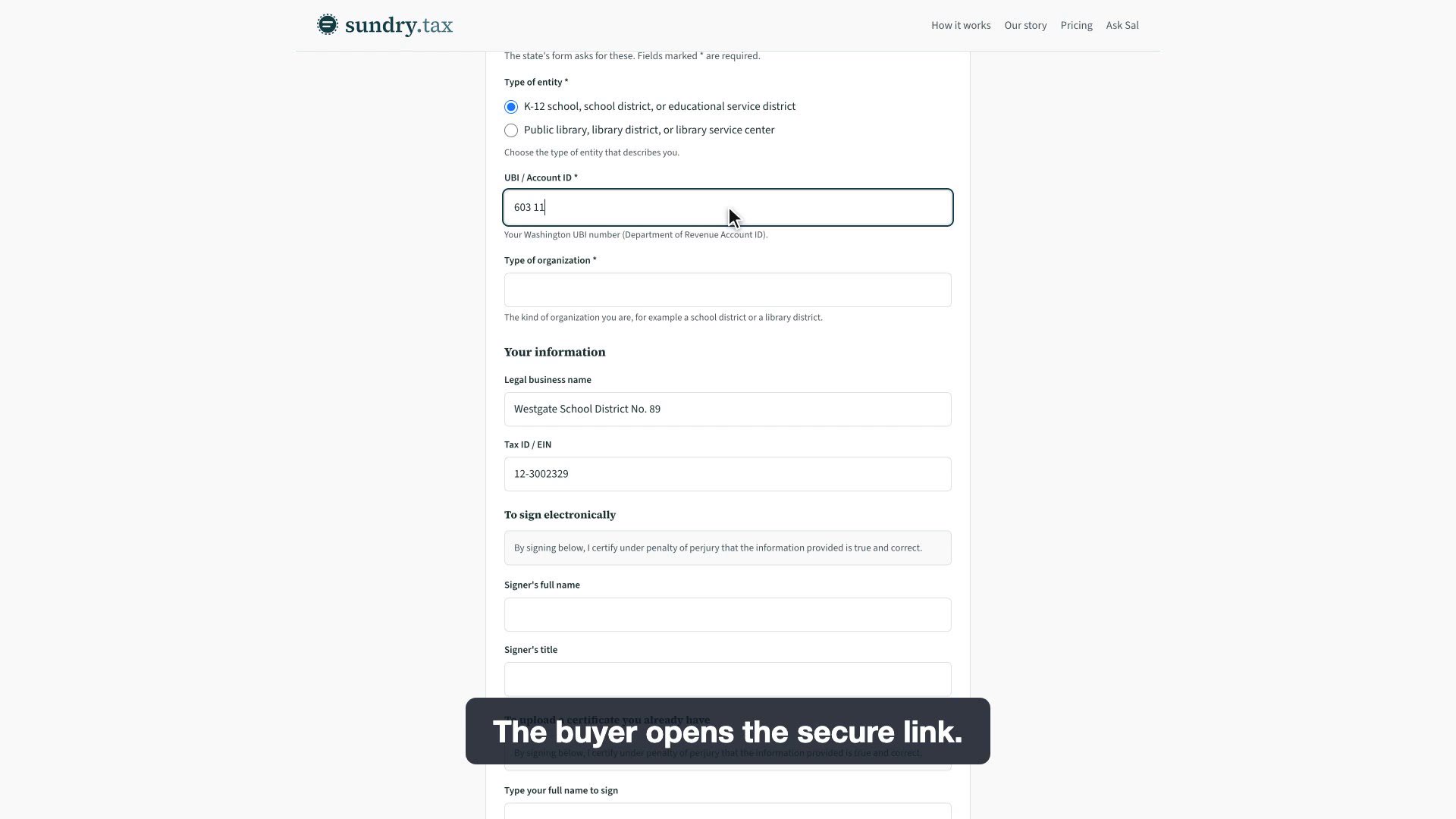
A firm asks the school or library for a signed REV 27-0063, the buyer fills in and signs it from the emailed link, and Sundry shows it signed and Verified by Sundry.
From July 1, 2026, public libraries, library districts, library service centers, K-12 schools, school districts and educational service districts pay no Washington sales or use tax on temporary staffing services: workers supplied by a staffing business for a limited time to fill vacancies or supplement staff. People the school hires directly, even short term, are not temporary staffing at all.
Who qualifies
- Public libraries, library districts and library service centers.
- K-12 schools, school districts and educational service districts.
- On form REV 27 0063 the buyer ticks one of two entity boxes: "K-12 school, school district, or educational service district" or "Public library, library district, or library service center."
What qualifies
- Temporary staffing services: providing workers to other businesses for limited periods to supplement their workforce and fill vacancies on a contract or fee basis. The current statute gives the term the meaning of "staffing service" in RCW 82.04.540.
- DOR looks for all of these: the staffing firm recruits and hires its own employees, finds organizations that need them, assigns them temporarily to work under the customer's direction and supervision (for absences, skill shortages, seasonal workloads or special projects), and customarily reassigns them when an assignment ends.
- Examples: an agency-supplied front office temp, custodial or food service staff supplied by an agency during a shortage.
- Use of temporary staffing is also exempt from use tax (RCW 82.12.710(1)(d)).
Not covered
- Direct hires. DOR: a worker the school hires and supervises directly, even for one term, is an employee, not temporary staffing (its examples include a school district hiring a math teacher for one year and a receptionist for three months).
- Job posting platforms that only connect the employer and the worker; the platform is taxed by what it actually sells.
- Independent contractors, unless what they provide meets the definition of a staffing service.
- Paymaster services, to the extent deductible under RCW 82.04.43393.
- Staffing purchased before July 1, 2026, unless DOR's existing contract treatment applied.
What the buyer gives
Form REV 27 0063 (revision 9/2/26). The buyer ticks single use or blanket (blanket suits an ongoing agency relationship with at least one sale every 12 months), enters the staffing firm's name, mailing address and date, ticks "Temporary staffing" under line 1 and its entity type under line 2, and completes and signs the certification block.
What the seller keeps
RCW 82.08.710(2): sellers "must obtain an exemption certificate from the purchaser in a form and manner prescribed by the department" and "must retain a copy of the exemption certificate for the seller's files." Form REV 27 0063 says: "Seller must retain the original of this certificate for their records. Do not send a copy of this certificate to the Department of Revenue." DOR's special notice says to keep the form for five years, and RCW 82.32.070(1) requires records to be kept for five years. Under RCW 82.08.050(7)(a) a seller is relieved of the tax if it obtains a fully completed certificate within 90 days after the sale; (7)(b) allows 120 days after a department request. DOR: report the sale under Retailing B&O and Retail Sales, then take the "Sales of Exempt Services to Libraries and Schools" deduction from Retail Sales. The retailing B&O tax still applies. A staffing firm should also keep its own record that the placement meets DOR's staffing factors; DOR says the burden to show the proper B&O classification rests with the taxpayer.
Common mistakes
- Asking a substitute or seasonal worker the district hired directly for a certificate. A direct hire is not a sale of staffing services; there is nothing to exempt.
- Using form REV 27 0063 for hospital staffing. Hospital placements are excluded from temporary staffing entirely, and DOR uses a different form, the Declaration for Purchases of Nonretail Temporary Staffing Services, for the hospital exclusion.
- Treating a 1099 contractor as a staffing purchase. DOR says independent contractor services are not staffing services unless they meet that definition.
- Forgetting the line 2 entity box. A certificate without the buyer's entity type is not fully completed.
Common questions
- Does a Washington school district pay sales tax on agency temps?
- Not from July 1, 2026. RCW 82.08.710(1)(e) exempts temporary staffing bought by school districts, and RCW 82.12.710(1)(d) exempts its use. The district gives the agency form REV 27 0063.
- Is a substitute teacher hired directly by the district subject to sales tax?
- No. DOR says workers the employer hires directly, on W-4 and I-9 and under its own supervision, are employees, not temporary staffing services, even for a short term.
- Can a library use a blanket certificate with its staffing agency?
- Yes. Form REV 27 0063 can be a blanket certificate while the library and the agency have at least one sale within 12 months.
- Does a job board subscription count as temporary staffing?
- No. DOR says a platform that only connects employers with workers who are then hired directly is not providing temporary staffing; it is taxed by what it sells.
Sources
- RCW 82.08.710 (1)(a)-(f), (2); effective July 1, 2026 (2026 c 238)
- RCW 82.12.710 (1)(a)-(e), (2) use tax
- RCW 82.04.050 (as amended by 2026 c 250) (3)(j)(i)-(iv)
- DOR form REV 27 0063 (9/2/26), Sales Tax Exemption Certificate for Purchases Certain Retail Services by Schools and Libraries Page 1 single use/blanket, line 1 type of purchase, line 2 type of entity; page 2 certification and retention
- DOR Special Notice (April 3, 2026): New sales/use tax exemption for purchases of certain retail services by schools and libraries Whole notice: reporting, documentation, pre-July 2026 sales, guidance status
- DOR Interim guidance: ESSB 5814 temporary staffing services Background and relevant law (factors); Services not considered temporary staffing services; Examples 3-6
- DOR Special Notice (April 3, 2026): Temporary staffing services: Modification to exclusion for staff provided to hospitals How do I document that the services are excluded?
- RCW 82.08.050 (4), (7)(a)-(c)
- RCW 82.32.070 (1) five-year record retention
- Form
- REV 27-0063: Sales Tax Exemption Certificate for Purchases Certain Retail Services by Schools and Libraries
- Statute
- RCW 82.08.710(1); RCW 82.12.710(1)
- Category
- Entity
- How the buyer provides it
- Signs the state form in the buyer portal