REV 27-0063
Custom software bought by a school or library
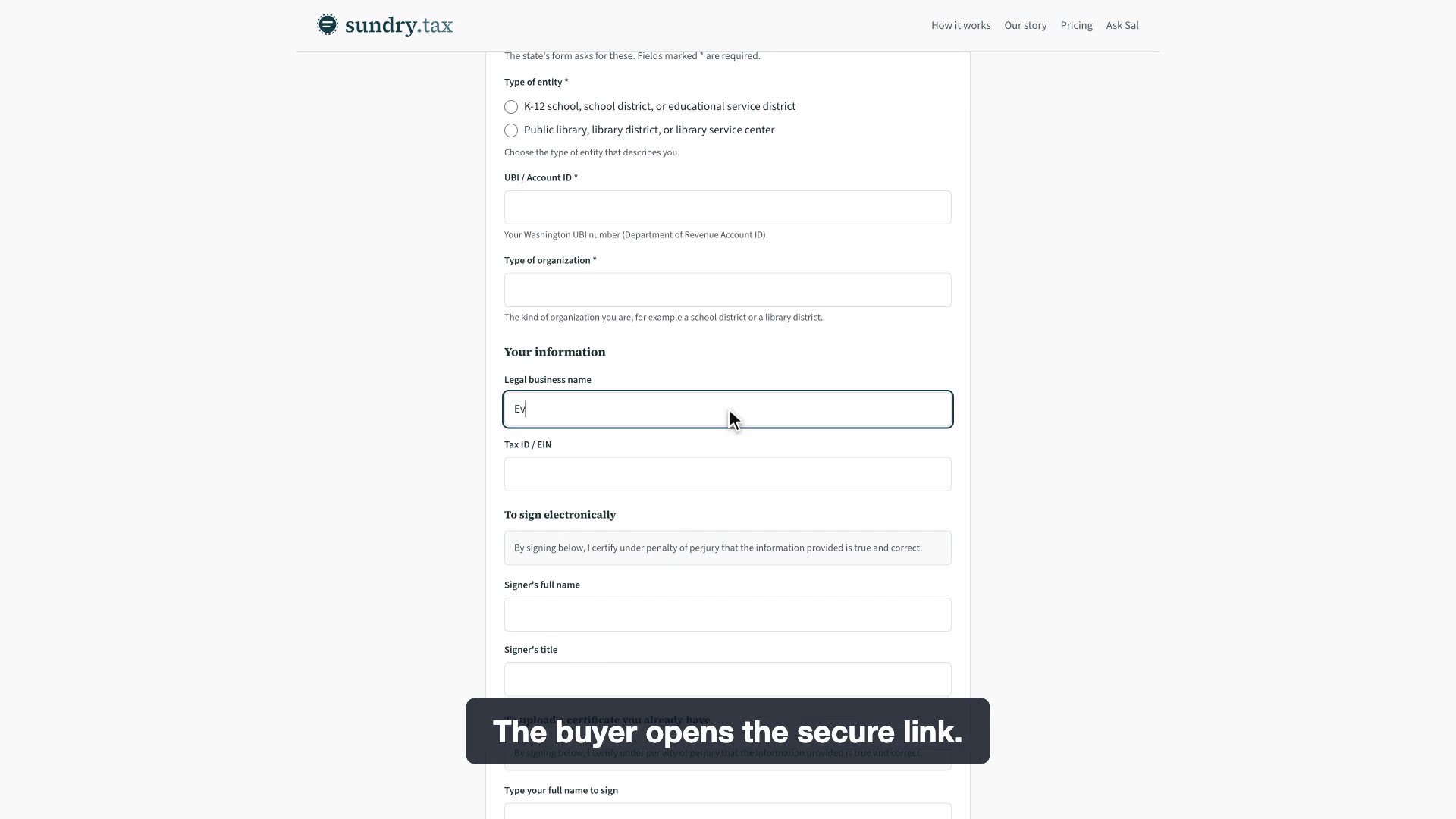
A firm asks the school or library for a signed REV 27-0063, the buyer fills in and signs it from the emailed link, and Sundry shows it signed and Verified by Sundry.
From July 1, 2026, K-12 schools, school districts, educational service districts, public libraries, library districts and library service centers pay no Washington sales or use tax on custom software or on customization of prewritten software. Off-the-shelf software stays taxable: the exemption covers the custom work, not the standard product.
Who qualifies
- Public libraries, library districts, library service centers, K-12 schools, school districts and educational service districts (RCW 82.08.710(1), 82.12.710(1)).
- Colleges and universities are not on the list.
- Purchases on or after July 1, 2026 (2026 c 238, ESSB 6346).
What qualifies
- "Custom software": software created for a single person (RCW 82.04.215(3)).
- "Customization of prewritten computer software": any alteration, modification or development of applications using or incorporating prewritten software for a specific person, including individualized configuration to work with other software and hardware (RCW 82.04.215(4)).
- Charges for the right to access and use custom or customized software kept on the seller's or a third party's server, whether billed per use, per user, per license or by subscription (DOR tax topic).
- DOR interim guidance: design, development, testing, implementation and installation services are part of the selling price of custom software.
- Use tax: RCW 82.12.710(1)(e). Sales tax: RCW 82.08.710(1)(f).
Not covered
- Unmodified off-the-shelf prewritten software, including its licenses and subscriptions. It is not custom software and is not on the exemption list.
- Routine installation, which the definition says is not customization.
- Separately contracted consulting unrelated to the custom software, which is taxed by its own nature (DOR interim guidance).
- Purchases before July 1, 2026, unless they met DOR's existing contract treatment.
- Buyers not on the list, such as colleges, state agencies and other local governments, which DOR's interim guidance says generally pay sales tax on these services.
What the buyer gives
Form REV 27 0063, Sales Tax Exemption Certificate for Purchases Certain Retail Services by Schools and Libraries (revision 9/2/26), which says it "Can be used for purchases on or after July 1, 2026." The buyer ticks single use or blanket (at least one sale within 12 months), enters the vendor's name, mailing address and the date, ticks the type of purchase, ticks the type of entity ("K-12 school, school district, or educational service district" or "Public library, library district, or library service center"), and completes the certification: type of organization, UBI/Account ID, organization name, buyer name and title, street address and signature. For this purpose the type of purchase is "Custom software or customization of prewritten software." The buyer must make sure it is entitled to the exemption before using the certificate.
What the seller keeps
RCW 82.08.710(2): sellers "must obtain an exemption certificate from the purchaser in a form and manner prescribed by the department" and "must retain a copy of the exemption certificate for the seller's files." Form REV 27 0063 says the seller "must retain the original of this certificate for their records" and not send it to the Department. DOR's special notice of April 3, 2026: keep the form five years; report the sale under the retailing B&O and retail sales tax classifications, then take the "Sales of Exempt Services to Libraries and Schools" deduction from retail sales tax. Retailing B&O tax still applies. DOR's interim guidance on custom software (Sept. 26, 2025) still governs what counts as custom software until permanent rules are adopted. RCW 82.32.070(1) requires taxpayers to "keep and preserve, for a period of five years, suitable records as may be necessary to determine the amount of any tax for which the taxpayer may be liable." Under RCW 82.08.050(4) a seller is not relieved of the tax unless it keeps proper records of exempt sales and provides them when the department asks; (7)(a) relieves a seller that obtains a fully completed certificate within 90 days after the sale, and (7)(b) allows 120 days after a department request to prove the sale was not taxable or obtain a fully completed certificate taken in good faith.
Common mistakes
- Using the certificate for a standard software license or subscription. Unmodified prewritten software is still taxable.
- Applying it to invoices for work before July 1, 2026, outside existing contract treatment.
- Ticking only "Information technology services" when the contract is for custom software. The form lists six types of purchase; tick each one that applies.
- A college or university using the form. Higher education is not on the entity list.
Common questions
- Do Washington school districts pay sales tax on custom software?
- Not for purchases on or after July 1, 2026. RCW 82.08.710 exempts custom software and customization of prewritten software bought by K-12 schools, school districts and educational service districts. The district gives the vendor form REV 27 0063.
- Is configuring a district's learning platform to work with its student system exempt?
- Individualized configuration of prewritten software to work with other software is customization under RCW 82.04.215(4), so the configuration work can qualify. The underlying off-the-shelf license stays taxable; customization does not change its taxability.
- Is there official guidance on the school and library exemption?
- DOR's special notice of April 3, 2026 says it has not issued an interim guidance statement, excise tax advisory or rule-making on this topic, and that vendors with tribal customers should request a ruling.
Sources
- RCW 82.08.710 (1)(f), (2); notes (effective July 1, 2026)
- RCW 82.12.710 (1)(e), (2)
- RCW 82.04.215 (3)-(4)
- RCW 82.04.050 (6)(a)-(b) (as amended by 2026 c 250)
- DOR form REV 27 0063 (9/2/26), Sales Tax Exemption Certificate for Purchases Certain Retail Services by Schools and Libraries Pages 1-2
- DOR special notice: New sales/use tax exemption for purchases of certain retail services by schools and libraries (Apr. 3, 2026) Whole notice
- DOR interim guidance: custom software (Sept. 26, 2025) Definitions; Examples 1-4; state and local governments
- DOR: Sales of custom software and customization of prewritten software Whole page
- DOR: ESSB 5814 interim guidance and upcoming rule-making Upcoming rule-making
- RCW 82.08.050 (4), (7)(a)-(c) seller records and certificate timing
- RCW 82.32.070 (1) five-year record retention
- Form
- REV 27-0063: Sales Tax Exemption Certificate for Purchases Certain Retail Services by Schools and Libraries
- Statute
- RCW 82.08.710(1); RCW 82.12.710(1)
- Category
- Entity
- How the buyer provides it
- Signs the state form in the buyer portal