Resale permit
Reseller permit (resale)
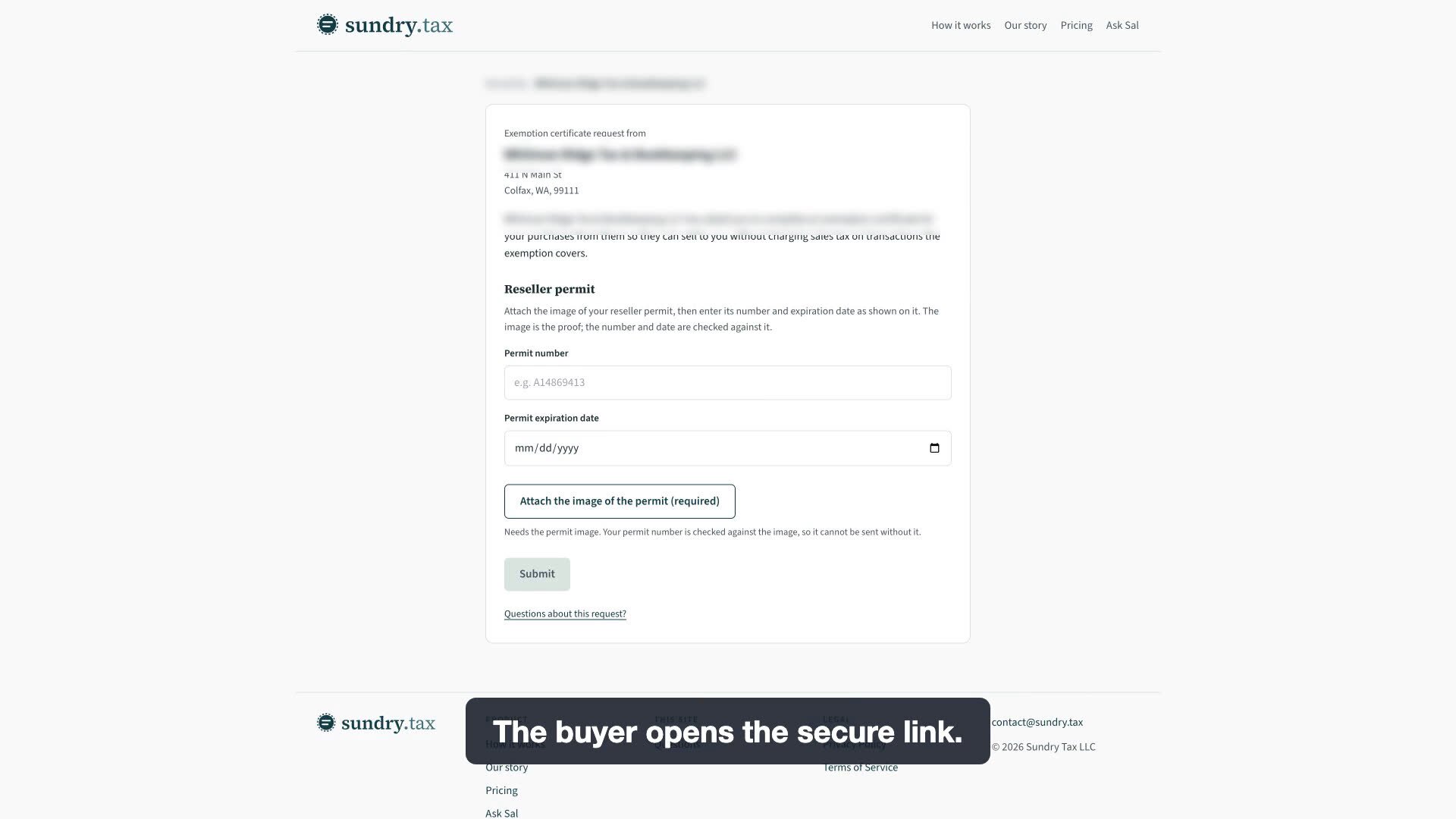
A firm asks a customer for a reseller permit, the buyer sends the permit image, number and expiration date, and Sundry reads the permit itself; if Sundry can’t confirm the permit, it isn’t counted until it’s resolved.
A Washington reseller permit is the document DOR issues so a business can buy goods or services for resale without paying sales tax. The seller treats every sale as retail unless it takes a copy of the buyer's permit, or an approved substitute, at the time of sale or within 120 days, and the permit's effective date must still be on or before the sale. A permit proves a wholesale purchase only; it cannot be used for exempt retail purchases.
Who qualifies
- A business registered in Washington that holds a reseller permit issued by DOR. DOR says it needs the right business licenses, endorsements and, if applicable, an L&I contractor's license.
- A buyer may let its employees use a copy of its permit on its behalf.
- A buyer not required to register in Washington can instead give the Multistate Tax Commission uniform certificate or the Streamlined Sales and Use Tax certificate (RCW 82.04.470(3)).
What qualifies
- Merchandise and inventory bought for resale without intervening use.
- Ingredients, components or chemicals used in processing new products for sale.
- Feed, seed, seedlings, fertilizer and spray materials for farmers.
- Materials and contract labor for retail or wholesale construction.
- Services bought for resale: DOR says services newly subject to sales tax can be resold with a reseller permit, for example IT work bought from a subcontractor and resold to the client without intervening use.
Not covered
- Items for personal or household use, or to be given away.
- Supplies and equipment used in the business, including items used in doing the work even if billed to customers.
- Tools or equipment, unless the business resells or rents out such items.
- Materials and contract labor for public road construction or U.S. government contracting, and equipment rentals.
- Exempt retail purchases. WAC 458-20-102(6): "The reseller permit may not be used when making tax-exempt retail purchases." Those need the exemption's own certificate.
What the buyer gives
A copy of its DOR-issued reseller permit. Each permit has a unique number; the last two digits are the year it expires, and the effective dates are in the upper-right corner. Permits are generally valid for four years, or two years for contractors and certain newer or non-reporting businesses. Instead of a permit copy, a registered buyer may give the Streamlined Sales and Use Tax uniform exemption certificate or another DOR-authorized certificate, which must include the buyer's reseller permit number (RCW 82.04.470(2)).
What the seller keeps
RCW 82.04.470(1): "The burden of proving that a sale is a wholesale sale rather than a retail sale is on the seller." WAC 458-20-102(7): the seller meets it by taking a copy of the permit "at the time of sale or within one hundred twenty days after the sale." Copies may be stored on paper or electronically. DOR: keep documentation for all wholesale sales for five years after the sale. Other accepted documentation: a printout of the customer's record from DOR's Business Lookup Tool, or a saved record from DOR's reseller permit lookup service for multiple records. Under RCW 82.04.470(6), a seller that keeps records showing it uses DOR's electronic system at least once each calendar year to check its customers' permits need not take copies for sales within the 12 months after that check. If none of this is on file, the seller owes the tax unless facts and circumstances show the sale was wholesale (WAC 458-20-102(7)(h)); in an audit the seller generally gets 120 days to produce documentation. Record the sale under the wholesaling B&O classification.
Common mistakes
- Accepting an expired permit. The last two digits of the permit number show the expiration year; purchases may not be made under a revoked or invalid permit.
- Accepting a permit for items the buyer will clearly use. WAC 458-20-102(7)(h) asks whether the items are consistent with the buyer's business; DOR says a seller may refuse a tax-exempt sale if it believes the permit is being misused.
- Buyers using the permit for office supplies or equipment. DOR: anyone found misusing a permit owes the tax plus a 50 percent penalty, even without intent to defraud.
- Taking a uniform certificate from a Washington-registered buyer without the reseller permit number on it. RCW 82.04.470(2)(b) requires it.
Common questions
- How long does a seller have to collect a reseller permit in Washington?
- At the time of sale or within 120 days after it (WAC 458-20-102(7)). For one order billed in stages, the 120 days run from the first billing. The permit's effective date must still be on or before the sale.
- Is a Washington reseller permit the same as the state's exemption forms?
- No. A reseller permit substantiates a wholesale purchase. WAC 458-20-102(5) says permits generally may not be used as proof of entitlement to retail sales tax exemptions.
- How long is a Washington reseller permit good for?
- Generally four years. DOR says two years if the holder is a contractor, has been open less than 12 months, reported no gross income or was on non-reporting status, or failed to file returns in the last 12 months.
- What happens if a customer misuses my reseller permit copy?
- The buyer, not the seller, owes the tax and a 50 percent penalty, and DOR may revoke the permit. A seller that took a valid permit in the ordinary way has met its burden of proof under RCW 82.04.470(1).
Sources
- RCW 82.04.470 (1)-(7)
- WAC 458-20-102 (2), (3), (4), (5), (6), (7)(a)-(m), (8), (9), (14)
- DOR Reseller permits What is a reseller permit?; Key things to know; Reseller permit misuse; Sellers: Accepting a reseller permit
- DOR: Services newly subject to retail sales tax Services now taxable table; Can these services be resold?
- DOR Interim guidance: ESSB 5814 information technology services Can IT Services be resold?
- Statute
- RCW 82.04.470(1); WAC 458-20-102(7)
- Category
- Resale permit