Department-issued
Qualified infrastructure project: coastal internet and telecommunications
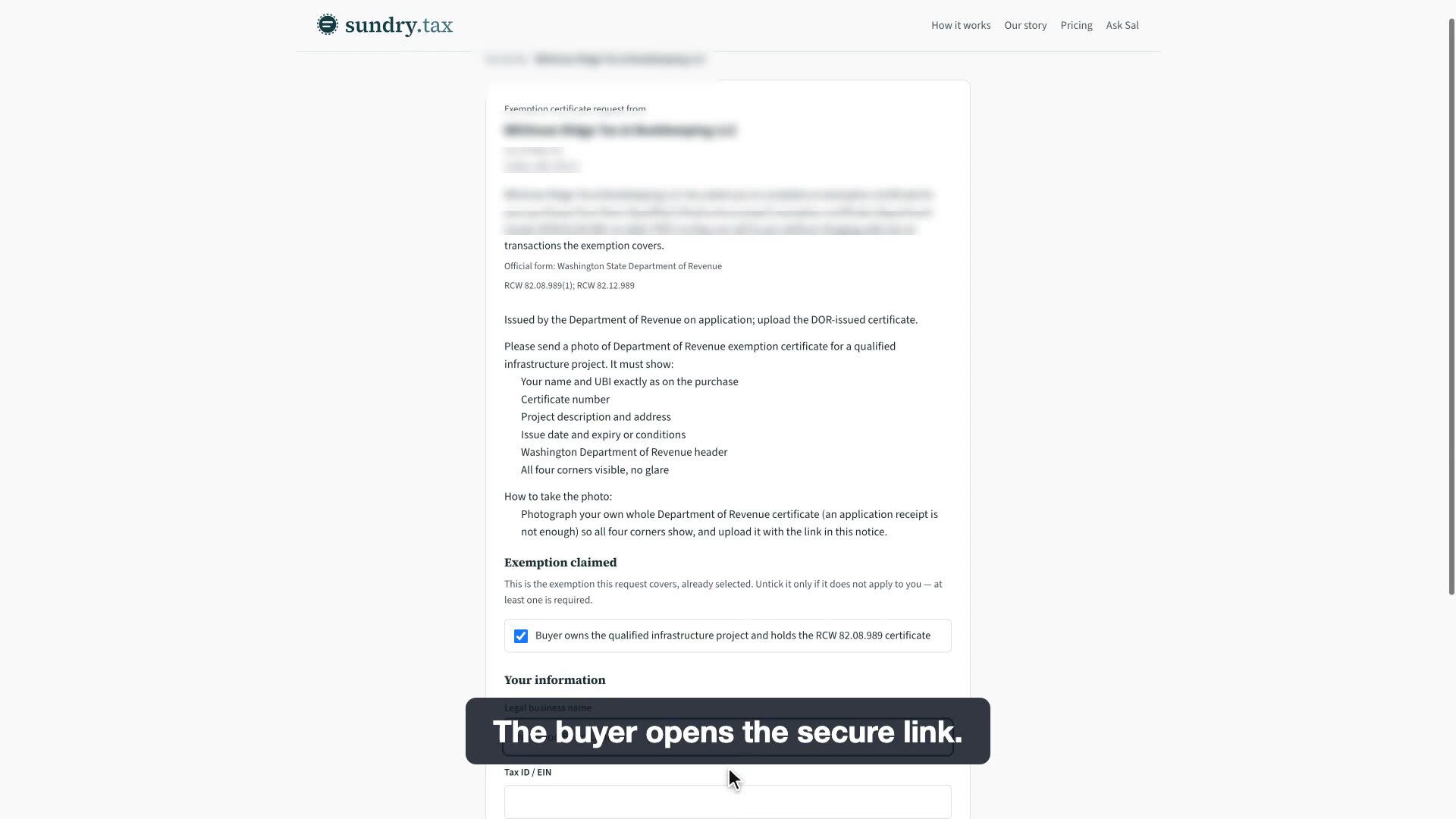
A firm asks a customer for the Department-issued certificate, the buyer uploads a photo of it from the emailed link, and Sundry shows it received and checked.
A wholly owned subsidiary of a federally recognized tribe in a county on the Pacific Ocean can buy building materials, telecommunications equipment and construction labor for a coastal internet and telecommunications project, such as a cable landing station, free of the state sales and use tax. Local sales and use tax still applies. The owner gets the certificate from DOR; the seller keeps a copy for five years. It ends January 1, 2030.
Who qualifies
- A qualified infrastructure project owner: a wholly owned subsidiary of a federally recognized tribe located in a county that borders the Pacific Ocean, developing a qualified infrastructure project.
- The project is construction of buildings and utilities for modern global internet and telecommunications infrastructure that occurs in part in a distressed area (RCW 43.168.020) on the Washington coast, such as cable landing stations, communications hubs, buried utility connections and related equipment and buildings that add broadband capacity.
- The owner must apply to DOR and hold the certificate DOR issues; it is effective on the date DOR receives the application.
What qualifies
- Building materials, telecommunications equipment and other goods incorporated into the project.
- Labor and services to construct the project, or to install equipment incorporated into it. DOR's examples: building materials, construction labor, telecommunication equipment.
- Only property and services received on or after July 1, 2023 and before January 1, 2030.
Not covered
- Local sales and use taxes (RCW 82.08.989(2), 82.12.989(2)); only the state portion is exempt.
- DOR's examples that do not qualify: dyed fuels, form lumber, tools, and rental of heavy equipment.
- Purchases after the certificate expires: on the date the owner certifies the project operationally complete, or January 1, 2030, whichever is first.
- State tax above the $8,000,000 program cap; the owner must pay any excess within 60 days after the certificate expires.
What the buyer gives
A copy of the certificate DOR issued to the project owner. DOR: "the qualified infrastructure project owner must provide a copy of the department of revenue issued exemption certificate to their seller." The owner applies to DOR with the information DOR requires; there is no buyer-completed form.
What the seller keeps
RCW 82.08.989(3)(b): the owner "must provide the seller with an exemption certificate in a form and manner prescribed by the department. The seller must retain a copy of the certificate for the seller's files." DOR: sellers give the exemption at the point of sale, keep a copy of the certificate "in their records for five years," take the deduction on the return under "Tribal Qualified Internet/Telecom Infrastructure Project," and keep reporting the income under the Retailing B&O classification. Collect the local sales tax: the exemption does not apply to local sales taxes.
Common mistakes
- Dropping all sales tax from the invoice. Only the state sales tax is exempt; local sales tax still applies.
- Exempting tools, form lumber, dyed fuel or heavy equipment rentals. DOR lists these as not qualifying.
- Selling to the tribe itself or to a contractor without the owner's certificate. The exemption is for the qualified project owner, a wholly owned tribal subsidiary, holding a DOR certificate.
- Continuing exempt sales after the project is operationally complete; the certificate expires then.
Common questions
- Is a cable landing station on the Washington coast exempt from sales tax?
- The state sales tax on its building materials, telecom equipment and construction labor is, when the buyer is a wholly owned subsidiary of a federally recognized tribe in a Pacific coast county holding a DOR certificate (RCW 82.08.989). Local sales tax still applies.
- How long does the seller keep the certificate?
- DOR says five years. RCW 82.08.989(3)(b) requires the seller to keep a copy.
- How does the seller report the exempt sale?
- Report it under Retailing B&O and Retail Sales, and take the "Tribal Qualified Internet/Telecom Infrastructure Project" deduction from retail sales tax (DOR).
- When does the exemption end?
- The certificate expires when the project is certified operationally complete or on January 1, 2030, whichever comes first, and the statute expires January 1, 2030.
Sources
- RCW 82.08.989 (1)-(6)
- RCW 82.12.989 (1)-(5) use tax
- DOR: Sales and Use Tax Exemption for Tribal Telecommunication Infrastructure Projects What qualifies; Examples that don’t qualify; Documenting the exemption; Definitions
- RCW 82.32.070 (1) five-year record retention
- Form
- Qualified infrastructure project exemption certificate
- Statute
- RCW 82.08.989(1); RCW 82.12.989
- Category
- Department-issued
- How the buyer provides it
- Uploads a photo of the Department-issued certificate