REV 27-0055
Prosthetic devices prescribed, fitted or furnished by a licensed professional
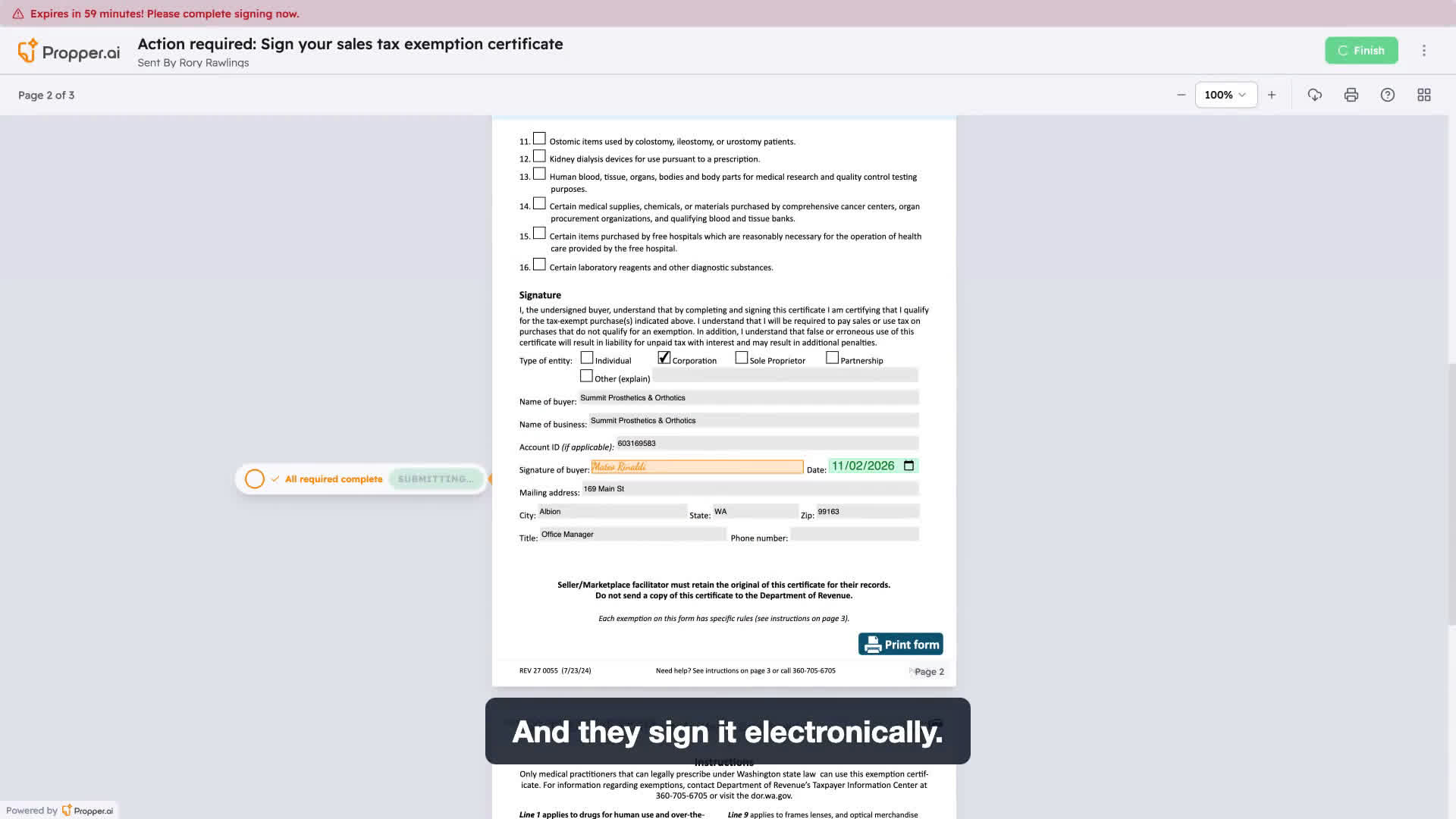
A firm asks a customer for this certificate, the buyer fills in and signs the form from the emailed link, and Sundry shows it signed and Verified by Sundry.
Prosthetic devices prescribed, fitted or furnished for an individual by a licensed professional are exempt from Washington sales and use tax, with their components, repair parts and repair labor. A prosthetic device is worn on or in the body. Wheelchairs, crutches, floor-standing machines and other medical equipment do not qualify.
Who qualifies
- Devices prescribed, fitted or furnished for an individual by a person licensed under Washington law to prescribe, fit or furnish prosthetic devices.
- Providers buying the devices use form REV 27 0055.
What qualifies
- A replacement, corrective or supportive device worn on or in the body to artificially replace a missing part of the body, prevent or correct a physical deformity or malfunction, or support a weak or deformed part of the body.
- Components, repair and replacement parts, and labor to repair, clean, alter or improve the device.
- WAC examples: artificial limbs, eyes and heart valves; hearing aids; cochlear implants; implanted pacemakers; insulin pumps; braces, splints, slings and cervical collars; orthopedic and diabetic shoes and inserts; compression stockings; stents; sutures, staples and skin glue; Foley catheters; CPAP machines designed to be wholly worn on the body.
- The matching use tax exemption is RCW 82.12.0277(1)(a).
Not covered
- Durable medical equipment (equipment not worn in or on the body), for example IV stands and medical beds.
- Mobility enhancing equipment, such as wheelchairs and crutches.
- Mobility enhancing equipment is not a prosthetic device, but it is exempt when bought for a complex needs patient (RCW 82.08.814; REV 27-0032 line 5bb). See the mobility enhancing equipment page (/exemption-proof/mobility-enhancing-equipment/).
- Devices that are partly floor-standing, plugged into an outlet, or moved on wheels or a cart. Examples: a non-wearable CPAP machine and its mask; a heart-lung machine.
What the buyer gives
Form REV 27 0055, Sales Tax Exemption Certificate for Health Care Providers (revision 7/23/24), line 8, "Prosthetic devices prescribed, fitted, or furnished by a licensed health care professional," with a description. Prescription lenses and frames (line 9) and dental prostheses (line 10) have their own lines under the same statute. The buyer ticks single use or blanket (valid while buyer and seller have at least one sale within 12 months), names the seller and the date, ticks the line for the exemption, and completes the signature block: type of entity, name of buyer, name of business, Account ID if any, signature, date, mailing address, title and phone. Only practitioners who can legally prescribe under Washington law may use the form; the form names chiropractors, East Asian medicine practitioners and massage practitioners as unable to use it.
What the seller keeps
Form REV 27 0055 says the seller or marketplace facilitator "must retain the original of this certificate for their records" and not send a copy to the Department of Revenue. WAC 458-20-18801(304): sellers to medical practitioners, nursing homes and hospitals must obtain an approved exemption form, capture the streamlined sales tax data elements, or otherwise meet RCW 82.08.050(7) for any exempt sale. A wearable device and its non-wearable base or accessories may be priced separately; tax what is not worn on or in the body. RCW 82.32.070(1) requires taxpayers to "keep and preserve, for a period of five years, suitable records as may be necessary to determine the amount of any tax for which the taxpayer may be liable." Under RCW 82.08.050(4) a seller is not relieved of the tax unless it keeps proper records of exempt sales and provides them when the department asks; (7)(a) relieves a seller that obtains a fully completed certificate within 90 days after the sale, and (7)(b) allows 120 days after a department request to prove the sale was not taxable or obtain a fully completed certificate taken in good faith.
Common mistakes
- Putting wheelchairs, walkers or crutches on line 8. They are mobility enhancing equipment, excluded by statute.
- Treating a device as worn because part of it attaches to the body. The WAC says the entire device must be worn and portable.
- Using line 8 for eyeglasses or dentures. The form has separate lines 9 and 10.
Common questions
- Are hearing aids taxable in Washington?
- No. Hearing aids are on the WAC list of prosthetic devices, exempt when prescribed, fitted or furnished by a licensed professional.
- Is repair of a prosthetic leg taxable?
- No. Repair and replacement parts and labor to repair, clean, alter or improve exempt prosthetic devices are exempt.
- Are wheelchairs exempt as prosthetic devices?
- No. RCW 82.08.0283(3) excludes mobility enhancing equipment, and the WAC lists wheelchairs as mobility enhancing equipment.
Sources
- RCW 82.08.0283 (1)(a), (2), (3), (4)(a)-(d)
- RCW 82.12.0277 (1)(a), (2)-(4)
- WAC 458-20-18801 (202) Table 1; (204) Table 3; (206)(a)-(c) Table 5, Examples 4-5; (304); (403)(n)
- DOR form REV 27 0055 (7/23/24), Sales Tax Exemption Certificate for Health Care Providers Lines 8-10; page 3 instructions, lines 8-10
- RCW 82.08.050 (4), (7)(a)-(c) seller records and certificate timing
- RCW 82.32.070 (1) five-year record retention
- Form
- REV 27-0055: Sales Tax Exemption Certificate for Health Care Providers
- Statute
- RCW 82.08.0283
- Category
- Use
- How the buyer provides it
- Signs the state form in the buyer portal