REV 27-0032
Motor vehicles, trailers and parts for carriers holding a motor carrier (MC) permit
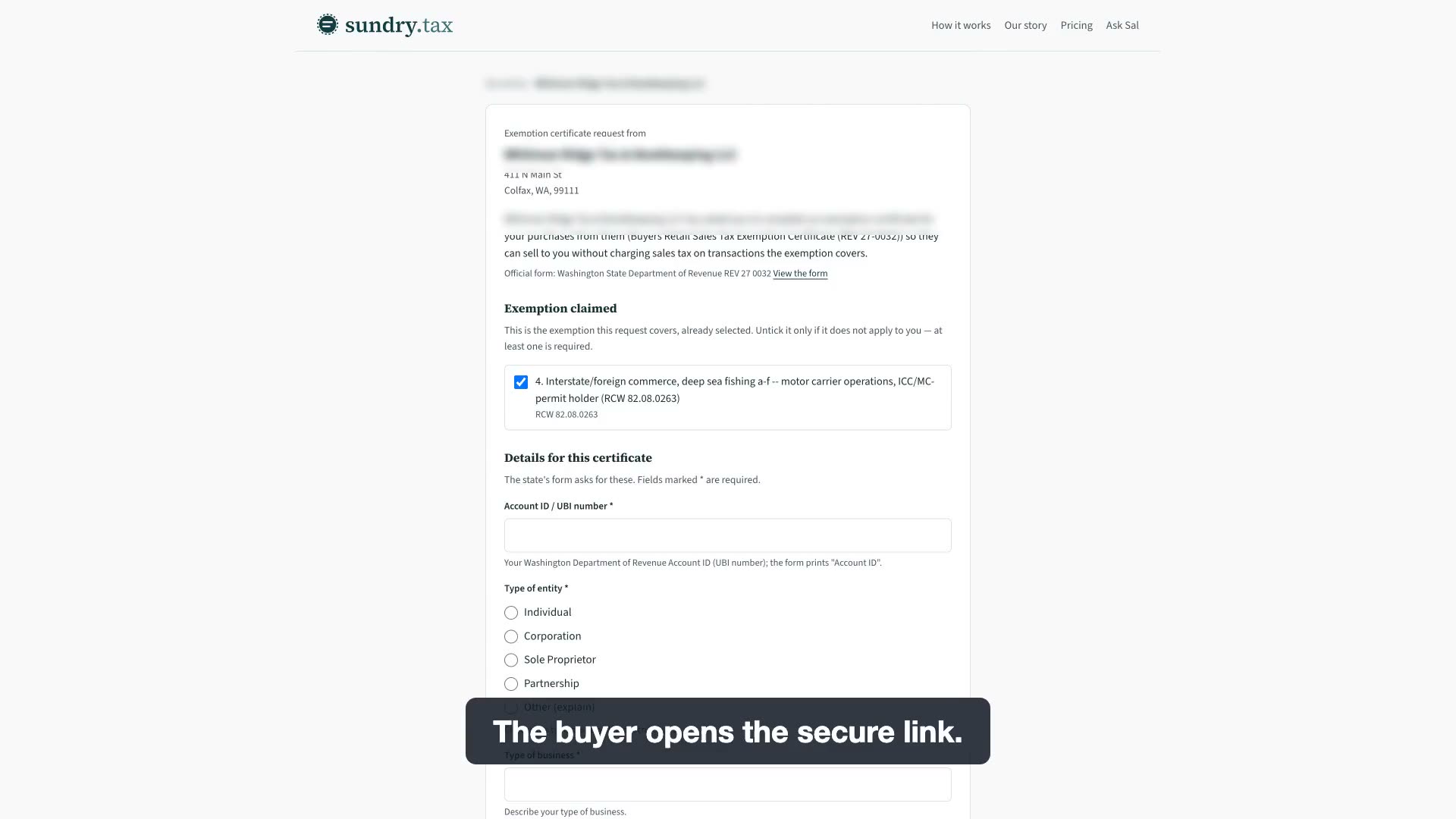
A firm asks a customer for this certificate, the buyer fills in and signs the form from the emailed link, and Sundry shows it signed and Verified by Sundry.
A for-hire motor carrier that holds a federal carrier permit, or a business operating under contract with one, pays no Washington sales tax on trucks, tractors and trailers used to haul people or property for hire in interstate or foreign commerce, or on component parts and repair labor for its for-hire vehicles. Buying tax-free is only the first test: to stay clear of use tax, each truck or tractor must actually cross the state line on at least 25 percent of its for-hire use, year after year.
Who qualifies
- The holder of a carrier permit issued by the Interstate Commerce Commission or its successor agency. Form REV 27 0032 calls this a motor carrier (MC) permit.
- A business operating vehicles under contract with a permit holder. The vehicle exemption applies whether the vehicle is used by the owner or leased to the user, with or without drivers.
- For vehicles and trailers: they must be bought to transport persons or property for hire in interstate or foreign commerce.
- For component parts and repairs: the permit must authorize transportation by motor vehicle across Washington boundaries and the vehicle must be used in hauling for hire. WAC 458-20-174 says this applies even if the vehicle will not be used substantially in interstate hauls.
What qualifies
- Sales and leases of motor vehicles and trailers used for interstate or foreign for-hire transportation.
- Component parts: property attached to and becoming an integral part of the vehicle or trailer, such as motors, motor and body parts, batteries, paint, permanently affixed decals and tires.
- The axle and wheels ("converter gear" or "dolly") used to connect a trailer behind a tractor and trailer.
- Items used as an integral part of operating the vehicle even if not mechanically required, such as cellular telephones, communication equipment and fire extinguishers, when permanently attached or held in brackets permanently attached to that vehicle.
- Spark plugs, oil filters, air filters, hoses and belts.
- Labor and services to construct, repair, clean, alter or improve the for-hire vehicles and trailers.
Not covered
- Antifreeze, oil, grease and other lubricants. The rule treats them as consumed when they are put in the vehicle.
- Equipment, tools, parts and accessories that do not become a component part of the vehicle or trailer.
- Consumable supplies such as cleaning solvents and ice.
- Towing charges.
- Parts and repairs for vehicles not used in hauling for hire. Carriers need the permit only to haul for hire, so the parts exemption follows that use.
- Vehicles bought by a buyer that neither holds a carrier permit nor operates under contract with a permit holder.
What the buyer gives
Form REV 27 0032 (revision 6/17/25), line 4a: "Motor vehicle, trailers and component parts thereof used to transport persons or property for hire in interstate or foreign commerce." The buyer ticks single use or blanket, enters the seller's name and mailing address and the date, checks 4a, lists the items purchased, and completes the certification block (type of entity, type of business, Account ID, buyer name and title, street address, signature). For vehicles and trailers the form instructions require an attached list stating make, model, year, serial number, motor number and MC permit number; the list is not required for parts. WAC 458-20-174(4) also accepts a certificate "in substantially the following form" that states the carrier permit number and, for a vehicle, the truck or trailer and make, motor number and serial number. A parts and repairs certificate may be issued for each purchase, incorporated in or stamped on the purchase order, or given in blanket form, valid while buyer and seller have at least one sale within 12 consecutive months.
What the seller keeps
WAC 458-20-174(4)(a): "The seller, at the time of the sale, must retain as a part of its records an exemption certificate that must be completed in its entirety." For parts and repairs, (4)(b)(ii): "The seller must retain as a part of its records a completed exemption certificate." B&O tax still applies: when the exemption requirements are met, the seller reports these sales, leases and repairs under the retailing of interstate transportation equipment B&O classification; sales that do not meet them, consumables, non-component accessories and towing go under retailing B&O. Form REV 27 0032 says: "Seller must retain the original of this certificate for their records. Do not send a copy of this certificate to the Department of Revenue." RCW 82.32.070(1) requires taxpayers to "keep and preserve, for a period of five years, suitable records as may be necessary to determine the amount of any tax for which the taxpayer may be liable." Under RCW 82.08.050(4) a seller is not relieved of the tax unless it keeps proper records of exempt sales and provides them when asked; (7)(a) relieves a seller that obtains a fully completed certificate within 90 days after the sale, and (7)(b) allows 120 days after a department request to prove the sale was not taxable or obtain a fully completed certificate taken in good faith.
Common mistakes
- Treating the tax-free purchase as the end of it. RCW 82.12.0254(3) exempts the use of the vehicle only if it is used "in substantial part" for for-hire hauls across state boundaries. WAC 458-20-17401 sets that at a minimum of 25 percent, reviewed for each truck and tractor every calendar or fiscal year by line crossings, mileage or revenue. If a vehicle falls short, use tax is due on its fair market value at the start of that view period, on the last return for the period.
- Counting the carrier's own freight. Substantial use is measured on for-hire hauling only, and once the exemption is lost the use tax is based on all in-state use, including hauling the carrier's own products.
- Counting a haul to a Washington port as interstate. A load picked up in Spokane and delivered to a Seattle dock for shipment to Japan is intrastate for the 25 percent test, because both points are in Washington (WAC 458-20-17401, Example 1).
- Putting oil, antifreeze, cleaning solvents or shop supplies on the certificate. The rule names them as taxable consumables.
- Sending the vehicle certificate without the list of make, model, year, serial number, motor number and MC permit number.
Common questions
- Do I need an MC permit to buy a semi-truck without Washington sales tax?
- You, or the carrier you operate for under contract, must hold a carrier permit issued by the Interstate Commerce Commission or its successor agency, and the truck must be used to haul persons or property for hire in interstate or foreign commerce.
- Are tires and repairs exempt for a for-hire truck that mostly runs inside Washington?
- Yes, if the user holds or operates under a carrier permit authorizing transportation across state boundaries and the truck is used in hauling for hire. WAC 458-20-174 says the parts exemption applies even if the vehicle is not used substantially in interstate hauls, and WAC 458-20-17401(7) gives the same answer for use tax on component parts.
- What happens if a tractor drops below 25 percent interstate use?
- Use tax is due on its fair market value at the start of the view period in which it fell short, reported on the last excise tax return for that period. If you do not keep records for each trailer, trailers are taxed by the fleet trailer-to-tractor ratio, rounded up.
- Can a leased truck or trailer qualify?
- Yes. Leases with or without operator qualify if the user is, or operates under contract with, a permit holder. A leased vehicle must meet the same 25 percent test; if it does not, use tax applies to each lease payment in the view period in which there was use in Washington.
Sources
- RCW 82.08.0263 Sales tax exemption for motor vehicles and trailers used for hire in interstate or foreign commerce
- RCW 82.08.0262 (1)(c)-(d) component parts and labor for motor vehicles and trailers of permit holders
- RCW 82.12.0254 (3) use tax exemption, "used in substantial part"
- WAC 458-20-174 (2)(a) component parts; (3) B&O; (4)(a)-(c) exemptions and certificates
- WAC 458-20-17401 (3) 25 percent substantial use, view periods, methods, examples; (4) trailers; (5) valuation; (6) leases; (7) component parts
- DOR form REV 27 0032 (6/17/25), Buyer's Retail Sales Tax Exemption Certificate Page 2 line 4a; page 4 certification; page 5 line 4a instructions
- RCW 82.08.050 (4), (7)(a)-(c) seller records and certificate timing
- RCW 82.32.070 (1) five-year record retention
- Form
- REV 27-0032: Buyers Retail Sales Tax Exemption Certificate
- Statute
- RCW 82.08.0263; WAC 458-20-174
- Category
- Use
- How the buyer provides it
- Signs the state form in the buyer portal