REV 27-0032
Mobility enhancing equipment for complex needs patients
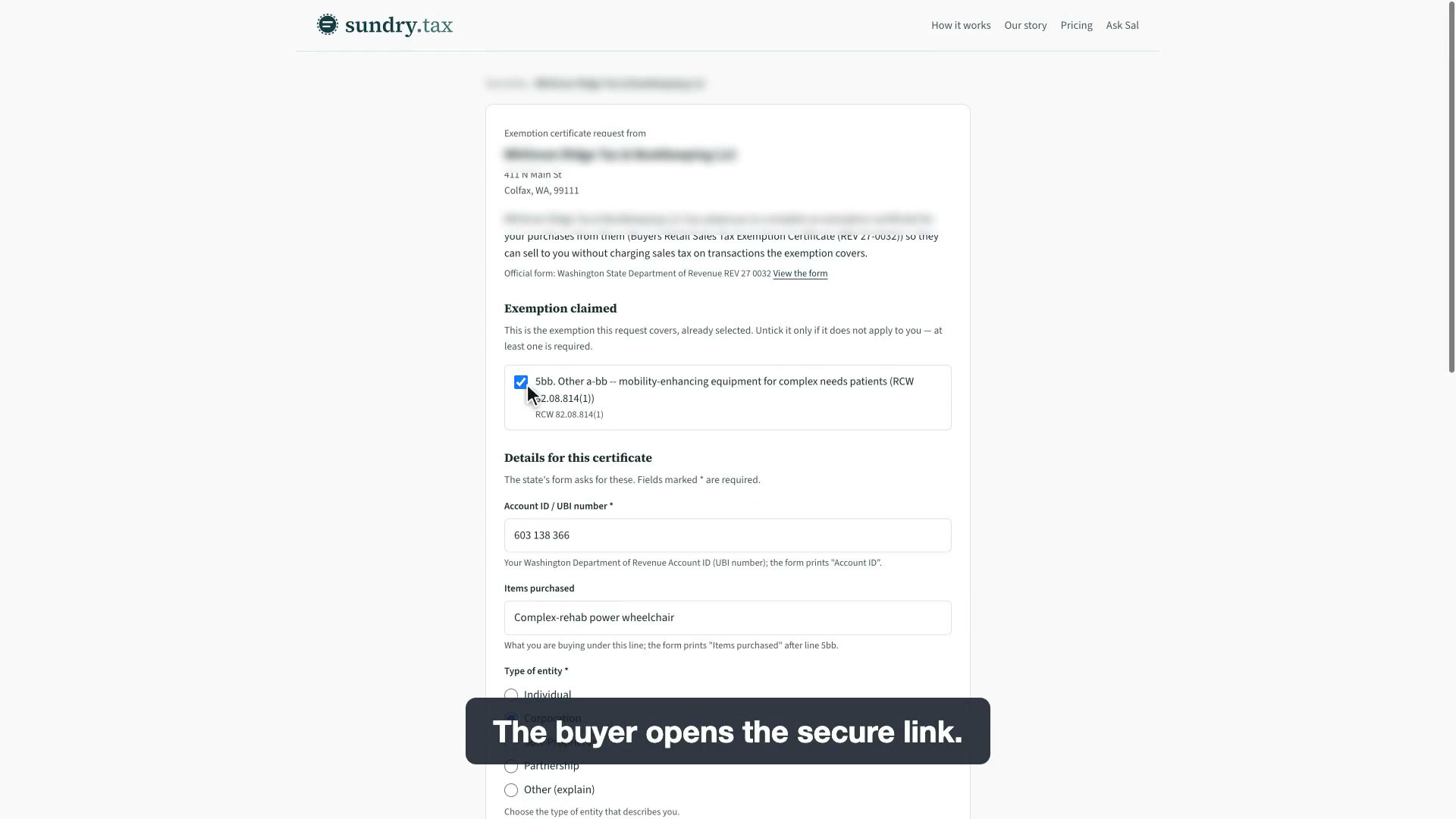
A firm asks a customer for this certificate, the buyer fills in and signs the form from the emailed link, and Sundry shows it signed and Verified by Sundry.
Since August 1, 2023, mobility enhancing equipment bought for a complex needs patient is exempt from Washington sales and use tax, with repair service and replacement parts. The equipment must meet the patient's specific needs for basic activities when medically necessary to prevent hospitalization or institutionalization. Mobility equipment for anyone else is still taxable, prescription or not.
Who qualifies
- A purchaser buying for use by or for a complex needs patient: an individual with a diagnosis or medical condition that results in significant physical or functional needs and capacities.
What qualifies
- "Mobility enhancing equipment": equipment, including repair and replacement parts, primarily and customarily used to provide or increase the ability to move from one place to another, appropriate for use in a home or a motor vehicle, and not generally used by people with normal mobility.
- It must meet the user's specific and unique medical, physical and functional needs and capacities for basic activities, when medically necessary to prevent hospitalization or institutionalization of the patient.
- Repair service and replacement parts for the equipment (WAC 458-20-18801).
- The rule's list of mobility enhancing equipment includes canes, crutches, lift chairs, patient lifts, bath aids, grab bars, mobility car seats, and replacement parts such as batteries for electric wheelchairs. Each must still meet the complex-needs test.
Not covered
- Mobility enhancing equipment for anyone who is not a complex needs patient. The rule says sales tax applies in most cases unless a specific exemption applies.
- The prescription-based medical exemption in RCW 82.08.0283 does not reach mobility enhancing equipment; it says so in (3).
- Motor vehicles, and equipment on a vehicle normally provided by its manufacturer.
- Durable medical equipment. The terms "durable medical equipment" and "mobility enhancing equipment" are mutually exclusive.
- Add-on vehicle adaptive equipment for disabled veterans. That is a separate exemption (line 5d).
What the buyer gives
The Buyer's Retail Sales Tax Exemption Certificate, form REV 27 0032 (6/17/25), line 5bb: "Mobility enhancing equipment for complex needs patients." The buyer ticks single use or blanket (blanket works while buyer and seller have at least one sale within 12 months), enters the seller's name, mailing address and the date, checks the line named below, lists the items purchased, and completes the certification block: type of entity, type of business, Account ID, buyer name and title, street address, and signature. The form says it is not for resale purchases. The form also notes that items prescribed for human use and other medical purchases go on the separate Sales Tax Exemption Certificate for Health Care Providers; that note does not change line 5bb.
What the seller keeps
RCW 82.08.814(2): "In order to claim an exemption under this section, the purchaser must provide the seller with an exemption certificate in a form and manner prescribed by the department. The seller must retain a copy of the certificate for the seller's files." WAC 458-20-18801(403)(m)(ii)(D) repeats the requirement and points to RCW 82.08.050(7). Form REV 27 0032 says: "Seller must retain the original of this certificate for their records. Do not send a copy of this certificate to the Department of Revenue." RCW 82.32.070(1) requires taxpayers to "keep and preserve, for a period of five years, suitable records as may be necessary to determine the amount of any tax for which the taxpayer may be liable." Under RCW 82.08.050(4) a seller is not relieved of the tax unless it keeps proper records of exempt sales and provides them when asked; (7)(a) relieves a seller that obtains a fully completed certificate within 90 days after the sale, and (7)(b) allows 120 days after a department request to prove the sale was not taxable or obtain a fully completed certificate taken in good faith. RCW 82.04.470 governs reseller permits and wholesale sales; it is not the documentation rule for this exempt retail sale.
Common mistakes
- Exempting a cane or walker for any customer with a prescription. Without the complex-needs test, mobility enhancing equipment is taxable.
- Exempting durable medical equipment such as hospital beds under this line. It is a different category.
- Charging tax on repairs and replacement parts for qualifying equipment. The rule includes them.
- Using the health care provider certificate. This exemption is on form REV 27 0032 line 5bb.
Common questions
- Is a custom power wheelchair for a patient with a spinal cord injury exempt?
- It can be, if the patient has a diagnosis or condition causing significant physical or functional needs and the chair meets the patient's specific needs when medically necessary to prevent hospitalization or institutionalization.
- Are replacement batteries for an exempt wheelchair taxable?
- No, if the chair qualifies. The rule says the exemption includes repair service and replacement parts, and it lists wheelchair batteries as mobility enhancing equipment.
- Does this exemption expire?
- No expiration date is set. The 2023 act exempts it from the automatic expiration in RCW 82.32.805.
- Is this on the health care provider certificate?
- No. It is line 5bb on the Buyer's Retail Sales Tax Exemption Certificate, REV 27 0032.
Sources
- RCW 82.08.814 (1)-(3); 2023 c 319 s 3 (application), s 4 (no automatic expiration)
- RCW 82.12.814 (1)-(2) use tax
- RCW 74.09.557 (3)(a) "complex needs patient"
- RCW 82.08.0283 (3), (4)(b)-(d)
- WAC 458-20-18801 (204), Table 3, (403)(m)(i)-(ii)
- DOR form REV 27 0032 (6/17/25), Buyer's Retail Sales Tax Exemption Certificate Page 1 single use/blanket; page 3 note on prescription items; page 4 line 5bb; page 8 line 5bb instructions; page 4 certification and retention
- RCW 82.08.050 (4), (7)(a)-(c) seller records and certificate timing
- RCW 82.32.070 (1) five-year record retention
- RCW 82.04.470 (1), (7) reseller permits and wholesale sales
- Form
- REV 27-0032: Buyers Retail Sales Tax Exemption Certificate
- Statute
- RCW 82.08.814(1)
- Category
- Use
- How the buyer provides it
- Signs the state form in the buyer portal