REV 27-0021
Manufacturing machinery & equipment
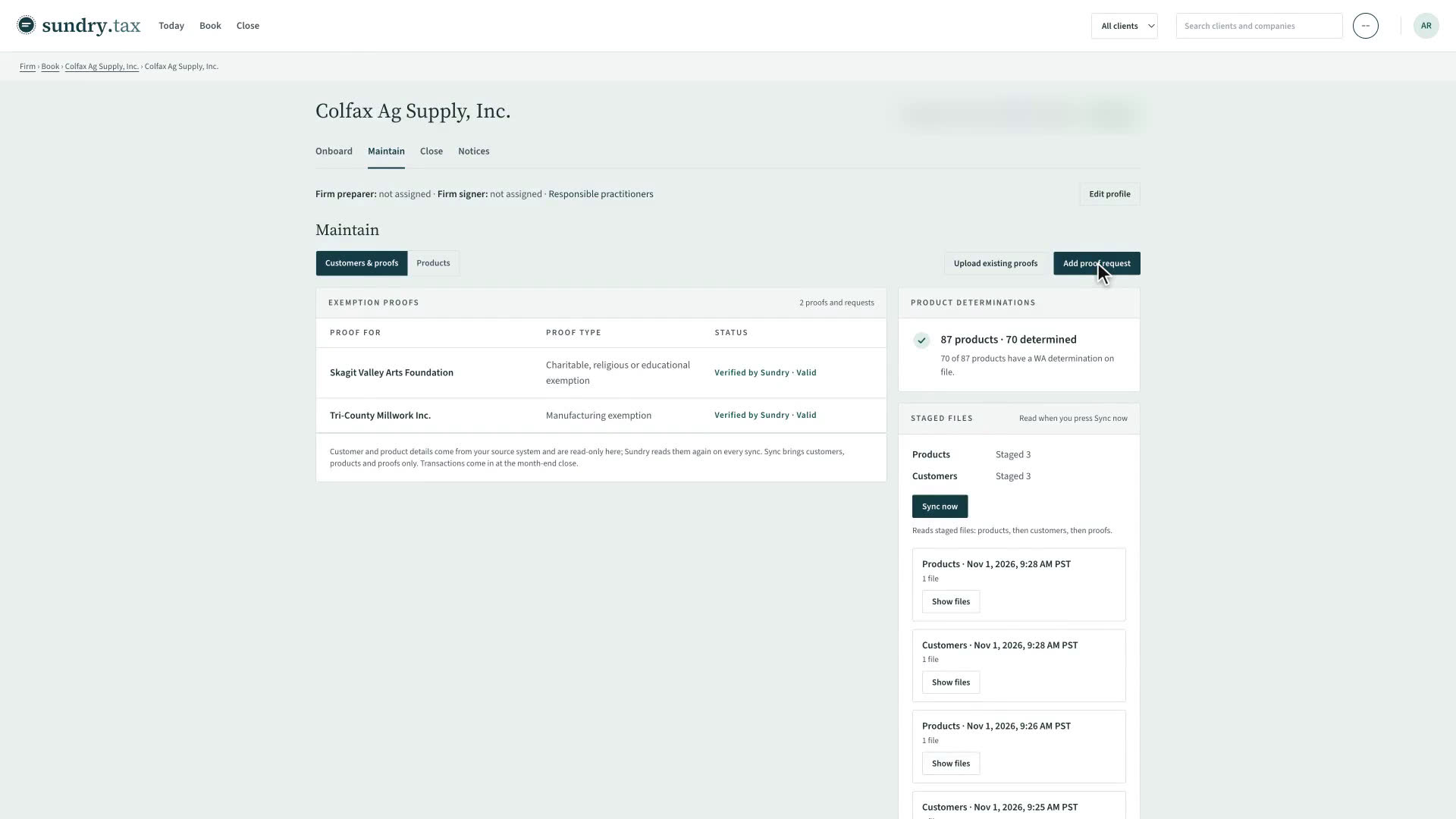
A firm asks a customer for this certificate, the buyer fills in and signs the form from the emailed link, and Sundry shows it signed and Verified by Sundry.
Manufacturers, processors for hire, and businesses that test for them pay no Washington sales or use tax on machinery and equipment used directly in manufacturing, research and development, or testing. Labor to install, repair, clean, alter or improve that equipment is exempt too.
Who qualifies
- A manufacturer or processor for hire that makes articles, substances or commodities for sale as tangible personal property.
- A person engaged in testing for a manufacturer or processor for hire.
- Also counted as manufacturers: printers of newspapers or other materials, and developers of prewritten software not delivered on tangible storage media.
- A processor for hire qualifies only if the manufacturer it works for will sell what is made, not use it.
- For research and development, the operation need not produce anything for sale.
- The business need not manufacture in Washington, but must meet the definition of manufacturer.
- DOR: generally the business must report under one or more manufacturing B&O tax classifications.
What qualifies
- Machinery and equipment: industrial fixtures, devices and support facilities, plus parts that become a component of them, including repair and replacement parts. Pollution control equipment used in the operation and digital goods are included.
- Labor and services to install, repair, clean, alter or improve qualifying machinery and equipment.
- The item must be "used directly." It qualifies if it acts on the product; conveys, handles or temporarily stores it at the site; controls, guides, measures, verifies, aligns, regulates or tests it; gives physical support or access to it; powers or lubricates machinery; produces another item used in the operation; packs the product into its normal sale or shipping package; or is integral to research and development.
- Examples from the rule and DOR: drill presses, band saws, rock crushers, forklifts, storage racks, tanks, robotic arms, catwalks next to production equipment, generators powering production machines, and software that controls production machinery.
- The item must have a useful life of one year or more, and qualifying use must be more than 50 percent of its use in a calendar year, measured by time, value, volume or another measure the department allows.
- Bare rentals of qualifying equipment, if all other conditions are met.
Not covered
- Hand-powered tools, such as screwdrivers, hammers, clamps, tape measures and wrenches. Electric and cordless tools are not hand-powered tools.
- Property with a useful life of less than one year, including consumables. Blades and bits generally fall here, as do one-time-use molds or forms.
- Buildings, and building fixtures not integral to the operation, such as heating, ventilation, air conditioning, plumbing, electrical and communications systems, fire sprinklers and washroom fixtures.
- Machinery and equipment for manufacturing, research or testing of cannabis, and labor on it.
- Food prepared on the premises of a business that sells food at retail.
- Equipment rented with an operator, unless the provider also installs the equipment (DOR).
- Books and repair manuals; the item must perform a task (DOR).
- Members of an "ineligible person" affiliated group as defined in RCW 82.08.02565(4).
What the buyer gives
The Sales and Use Tax Exemption Certificate for Manufacturing Machinery and Equipment, form REV 27 0021 (revision 6/16/21). The buyer ticks single use or blanket, enters the seller's or marketplace facilitator's name, the buyer's UBI number/Account ID, name and mailing address, then signs with title and date. By using it the buyer agrees it is a qualified manufacturer, processor for hire or tester for one, and that it will use the items directly in a manufacturing, processing for hire or testing operation. WAC 458-20-13601 requires the certificate to be completed in its entirety. A blanket certificate stays valid while the buyer and seller have at least one sale within 12 consecutive months.
What the seller keeps
RCW 82.08.02565(1)(b): sellers "must obtain from the purchaser an exemption certificate" and "must retain a copy of the certificate for the seller's files." Form REV 27 0021 says the seller "must retain the original of this certificate for their records" and not send it to the Department. RCW 82.32.070(1) requires taxpayers to "keep and preserve, for a period of five years, suitable records as may be necessary to determine the amount of any tax for which the taxpayer may be liable." Under RCW 82.08.050(4) a seller is not relieved of the tax unless it keeps proper records of exempt sales and provides them when asked; (7)(a) relieves a seller that obtains a fully completed certificate within 90 days after the sale, and (7)(b) allows 120 days after a department request to prove the sale was not taxable or obtain a fully completed certificate taken in good faith. DOR: report the sale under Retailing B&O and Retail Sales, take the manufacturing machinery deduction from Retail Sales, and keep the certificate or proof of delivery. The retailing B&O tax still applies. RCW 82.04.470 governs wholesale sales and reseller permits; it is not the documentation rule for this exemption.
Common mistakes
- Putting consumables on the certificate. Blades, bits and one-time-use molds generally have a useful life under one year and do not qualify; the form also lists consumable items as excluded.
- Treating building systems as equipment. Heating, ventilation, air conditioning, plumbing, electrical systems, fire sprinklers and washroom fixtures are excluded unless integral to the operation.
- Missing the majority use test. Equipment also used off site, such as a saw used to build cabinets at customer locations or a forklift unloading at customer sites, qualifies only if qualifying use is more than 50 percent, and the buyer must keep records of the measure. If it later fails the test, use tax is due on its fair market value.
- Using a reseller permit instead. DOR says a reseller permit may not be used to buy equipment or supplies used in the business.
Common questions
- Does a manufacturer need a reseller permit to buy machinery tax-free?
- No. The machinery exemption uses form REV 27 0021, which asks for the buyer's UBI number/Account ID, not a reseller permit. DOR says a reseller permit may not be used to buy equipment used in the business; it is for items bought for resale and for ingredients or components of new products for sale.
- Are repair parts and repair labor on production equipment exempt?
- Yes, for qualifying equipment, if the parts have a useful life of one year or more. When a repair charge covers both qualifying and nonqualifying parts, the labor is presumed exempt. If all the parts are nonqualifying, the labor is taxable, unless the parts are incidental to work such as cleaning, calibrating or adjusting.
- Does a forklift qualify for the manufacturing equipment exemption?
- It can. The rule lists forklifts as equipment that conveys or handles product at the manufacturing site. It must be used more than 50 percent of the time in the qualifying operation over a calendar year.
- Do I need a new certificate for every purchase from the same supplier?
- No. Form REV 27 0021 can be a blanket certificate, valid while you and the seller have at least one sale within 12 months. Do not send it to the Department of Revenue; the seller keeps it.
Sources
- RCW 82.08.02565 (1)(a)-(b), (2)(a)-(f), (3), (4)
- RCW 82.12.02565 (1)-(4) use tax exemption
- WAC 458-20-13601 (2), (3)(a)-(b), (4)-(9)
- DOR form REV 27 0021 (6/16/21) Pages 1-2
- DOR Manufacturing guide: Manufacturer's sales/use tax exemption for M&E Basic overview; What qualifies; What doesn’t qualify; Renting or leasing; Reporting/documentation
- DOR Reseller permits What is a reseller permit?; Reseller permit misuse
- RCW 82.08.050 (4), (7)(a)-(c)
- RCW 82.32.070 (1) five-year record retention
- RCW 82.04.470 (1), (7) reseller permits and wholesale sales
- Form
- REV 27-0021: Sales and Use Tax Exemption Certificate for Manufacturing Machinery and Equipment (6/16/21)
- Statute
- RCW 82.08.02565(1)(a); RCW 82.12.02565; WAC 458-20-13601
- Category
- Use
- How the buyer provides it
- Signs the state form in the buyer portal