REV 27-0055
Laboratory reagents and other diagnostic substances
A firm asks a customer for this certificate, the buyer fills in and signs the form from the emailed link, and Sundry shows it signed and Verified by Sundry.
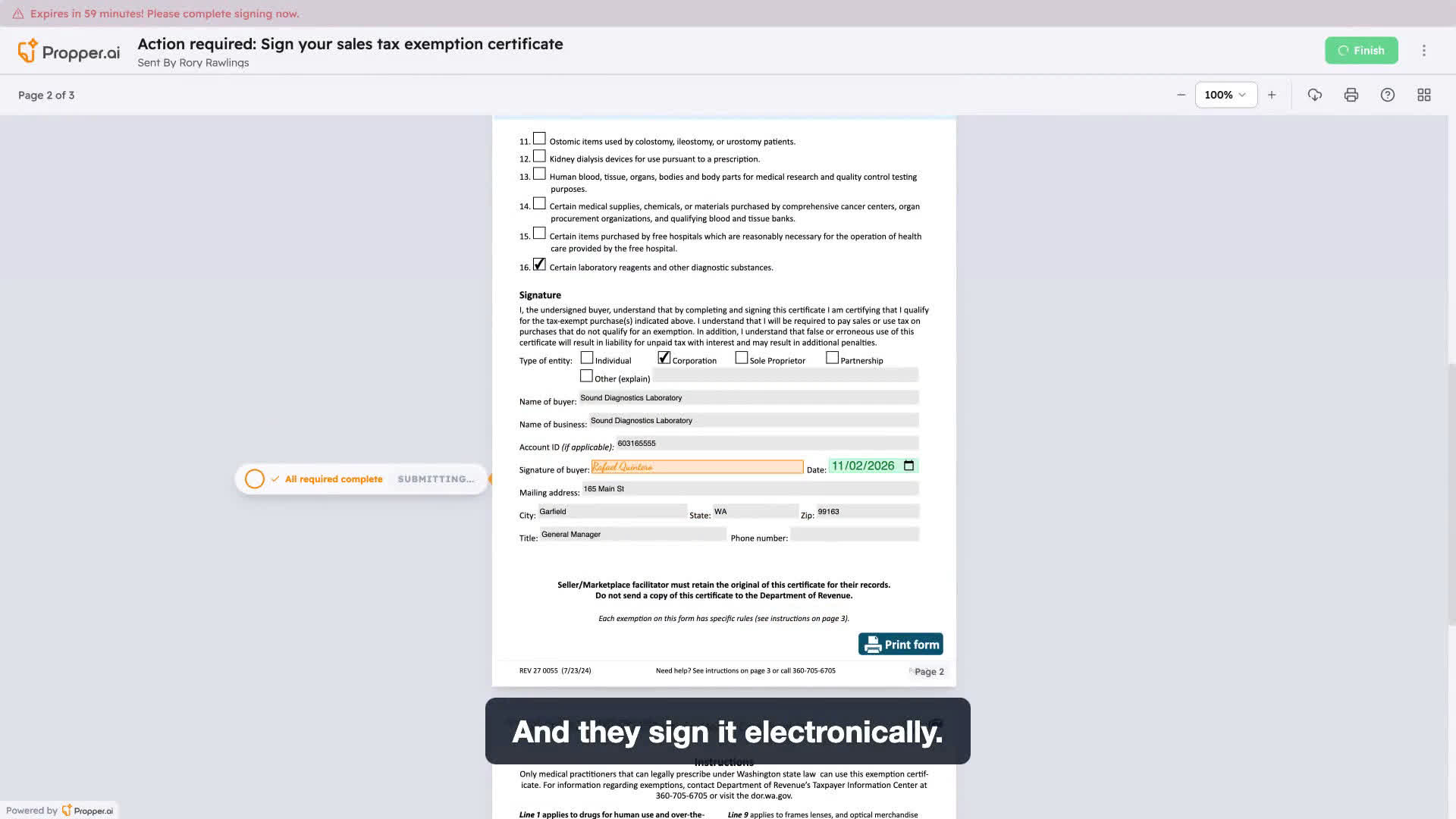
Laboratory reagents and diagnostic substances count as drugs, so they are exempt from Washington sales and use tax when prescribed for an individual and used to diagnose or treat disease in humans. The test is chemical contact: the substance must physically interact with a specific patient's specimen. Controls, calibrators, standards and specimen-handling supplies stay taxable.
Who qualifies
- Licensed practitioners, and the laboratories, clinics and hospitals buying for them, who use reagents in tests prescribed for an individual patient. Form REV 27 0055 line 16 applies to "purchases by a licensed practitioner."
What qualifies
- Substances that produce a chemical reaction to detect, measure or produce other substances, applied to a patient's specimen to identify the characteristics of a disease.
- WAC examples: stains, dyes and decolorizers that react with cellular tissue; decalcifying solution, dehydrating solution and clearing agents that chemically react with the specimen; test strips impregnated with a reagent.
- Prepared media, including transport media when the culture grown is used in diagnostic tests for specific patients. A container does not change the result.
- The exemption rests on the definition of "drug" in RCW 82.08.0281(4)(b), which includes substances intended for diagnosis of disease. The matching use tax exemption is RCW 82.12.0275.
Not covered
- Controls, calibrators and standards used with laboratory test equipment. They do not interact with a patient's specimen.
- Items that only prepare or hold a specimen: paraffin and gelatin extracted without chemically altering cells, electrodes, tissue cassettes, freezing medium, liquid agar used to gel specimens, plain test tubes, plain slides and cover slips, and mounting medium.
- Acids and other solutions used for cleaning, and alcohol used to clean counters or furniture.
- Tests not prescribed for an individual. WAC example: an employer's drug test kits for job applicants are taxable.
What the buyer gives
Form REV 27 0055, Sales Tax Exemption Certificate for Health Care Providers (revision 7/23/24), line 16, "Certain laboratory reagents and other diagnostic substances." The instructions say the reagents "must be prescribed to an individual and interact with a specific patient's specimen." The buyer ticks single use or blanket (valid while buyer and seller have at least one sale within 12 months), names the seller and the date, ticks the line for the exemption, and completes the signature block: type of entity, name of buyer, name of business, Account ID if any, signature, date, mailing address, title and phone. Only practitioners who can legally prescribe under Washington law may use the form; the form names chiropractors, East Asian medicine practitioners and massage practitioners as unable to use it.
What the seller keeps
Form REV 27 0055 says the seller or marketplace facilitator "must retain the original of this certificate for their records" and not send a copy to the Department of Revenue. WAC 458-20-18801(304): sellers to medical practitioners, nursing homes and hospitals must obtain an approved exemption form, capture the streamlined sales tax data elements, or otherwise meet RCW 82.08.050(7) for any exempt sale. Lab suppliers selling mixed orders should charge tax on controls, calibrators, standards and specimen-handling supplies even when the buyer gives a line 16 certificate. RCW 82.32.070(1) requires taxpayers to "keep and preserve, for a period of five years, suitable records as may be necessary to determine the amount of any tax for which the taxpayer may be liable." Under RCW 82.08.050(4) a seller is not relieved of the tax unless it keeps proper records of exempt sales and provides them when the department asks; (7)(a) relieves a seller that obtains a fully completed certificate within 90 days after the sale, and (7)(b) allows 120 days after a department request to prove the sale was not taxable or obtain a fully completed certificate taken in good faith.
Common mistakes
- Buying quality control materials and calibrators tax-free. The WAC names them as taxable.
- Treating every lab consumable as a reagent. Slides, cover slips, cassettes and mounting medium are named as not reagents.
- Buying multi-use substances such as alcohol all exempt. They are exempt only to the extent used in a prescribed diagnostic test; follow the principal use rule in WAC 458-20-18801(303).
Common questions
- Are lab reagents exempt from sales tax in Washington?
- Yes, when they are prescribed for an individual, physically interact with that patient's specimen, and are used to diagnose, cure, mitigate, treat or prevent disease in humans.
- Are quality control solutions and calibrators exempt?
- No. WAC 458-20-18801(403)(k) says controls, calibrators and standards are taxable because they do not interact with a patient's specimen.
- Is a pre-filled tube of reagent exempt?
- It can be. The WAC says the container makes no difference; the function of the substance decides. An empty tube is taxable.
Sources
- RCW 82.08.0281 (1), (4)(a)-(b)
- RCW 82.12.0275 (1), (4)
- WAC 458-20-18801 (303); (304); (403)(d) Example 11; (403)(j)(i)-(v); (403)(k)
- DOR form REV 27 0055 (7/23/24), Sales Tax Exemption Certificate for Health Care Providers Line 16; page 3 instructions, line 16
- RCW 82.08.050 (4), (7)(a)-(c) seller records and certificate timing
- RCW 82.32.070 (1) five-year record retention
- Form
- REV 27-0055: Sales Tax Exemption Certificate for Health Care Providers
- Statute
- RCW 82.08.0281
- Category
- Use
- How the buyer provides it
- Signs the state form in the buyer portal