REV 27-0036
Farmworker housing construction materials and services
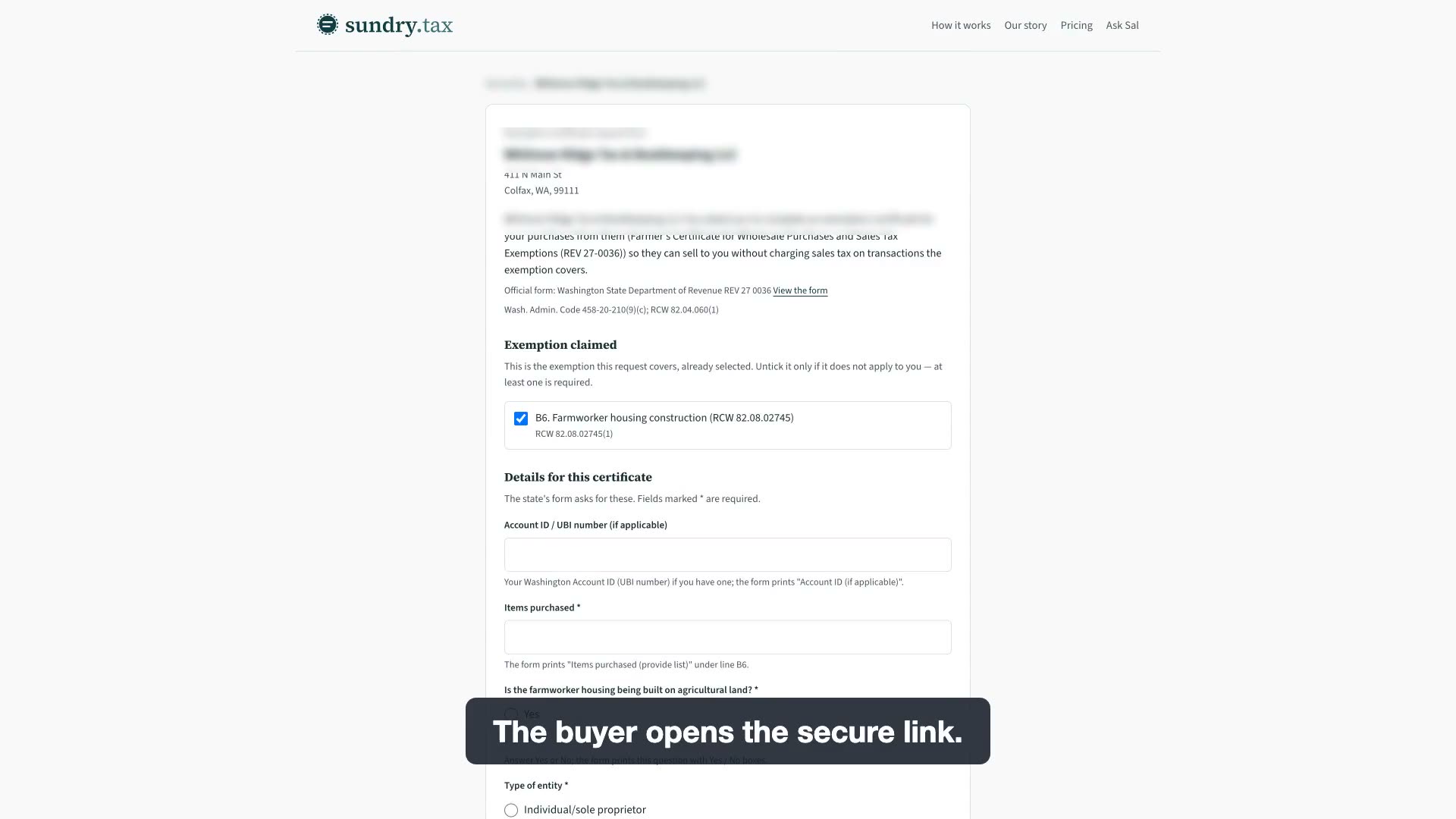
A firm asks a customer for this certificate, the buyer fills in and signs the form from the emailed link, and Sundry shows it signed and Verified by Sundry.
Construction, repair and improvement of housing developments where at least half the units house farmworkers are exempt from Washington sales and use tax, for both the labor and the materials that become part of the buildings. The housing must then be used as farmworker housing for five consecutive years, or the tax comes due with interest. Both statutes expire January 1, 2032.
Who qualifies
- Any person buying the qualifying labor or materials; the statute covers labor and services "rendered by any person."
- "Farmworker housing" is housing provided by an agricultural employer, housing authority, local government, state or federal agency, 501(c) tax-exempt nonprofit community or neighborhood-based organization, or for-profit housing provider, for farmworkers on a year-round or seasonal basis.
- "Farmworker": a single person or a household whose combined income from farm work is at least $3,000 per calendar year.
- At least 50 percent of the housing units in the development must be used as farmworker housing; the exemption then covers all units in the development.
What qualifies
- Labor and services to construct, repair, decorate or improve new or existing buildings or other structures in the development.
- Materials that become an ingredient or component of the buildings, such as cement, lumber, nails, paint and wallpaper.
- Appliances and furniture bolted or strapped directly to the building, or to another item that is bolted or strapped to it, such as stoves, refrigerators, bed frames, lamps and television sets.
- Labor and transportation to move and set up mobile homes, mobile bunkhouses and other property as farmworker housing.
- Farmworker housing may include mobile homes, travel trailers, mobile bunkhouses, modular homes, fabricated house components and tents, along with bathing, food handling, laundry and toilet facilities and dormitories.
Not covered
- Housing built for the occupancy of the employer, the employer's family, or people owning stock or shares in a farm partnership or corporation.
- Housing built exclusively for H-2A visa workers (RCW 82.08.02745(4); WAC 458-20-262(3)(f)).
- Housing regularly provided on a commercial basis to the general public.
- Housing authority housing, unless at least 80 percent of occupants are farmworkers with adjusted income below 50 percent of county median family income.
- Housing for workers growing, raising or producing cannabis.
- Items not bolted or strapped to the structure, such as kitchen utensils, mattresses, bedding, portable heaters and throw rugs.
- Year-round housing not built to the current state building code for single-family or multifamily dwellings.
What the buyer gives
Form REV 27 0036 (revision 7/13/23), Section B line 6 ("Farmer housing"), with the items purchased and the answer to "Is the farmworker housing being built on agricultural land?" WAC 458-20-262 names this certificate as the way to meet the certificate requirement. An agricultural employer that titles a new mobile home bought from an out-of-state seller, or retitles a used one, must give a completed exemption form to the Department of Licensing or its agent. The signature block asks for Account ID (if applicable), type of entity, name of buyer, farm name, mailing address, authorized signature, date, title and phone number. By signing, the buyer states it qualifies, that it "must keep records to verify the exempt nature of the sale," and that misuse "will result in taxes due, applicable interest, and possible penalties." The form has no field for the seller's name. The buyer ticks single use or blanket; a blanket certificate stays valid while there is at least one sale within 12 months. Cannabis growers and producers cannot use the form.
What the seller keeps
WAC 458-20-262(3)(h)(iv): the seller "may accept a legible fax or duplicate copy of an original exemption certificate. In all cases, the exemption certificate must be retained by the seller for a period of at least five years." A certificate for multiple purchases is valid while there is at least one sale within 12 consecutive months. Form REV 27 0036 says the seller "must retain the original of this certificate for their records" and must not send a copy to the Department, and: "A seller who accepts this completed certificate is relieved of the responsibility to collect retail sales or use tax unless the seller fraudulently fails to collect the tax or solicits the purchaser to participate in unlawfully claiming the exemption." The certificate does not expire while buyer and seller have at least one sale within twelve consecutive months; after a longer gap the seller must obtain a new form. WAC 458-20-210(10): "Without proper documentation, sellers are liable for payment of the retail sales tax on sales claimed as exempt." RCW 82.32.070(1) requires records to be kept for five years, and RCW 82.08.050(7)(a)-(b) gives the 90-day and 120-day windows for obtaining a fully completed certificate.
Common mistakes
- Missing the five-year use rule. If the housing is not used as farmworker housing for five consecutive years from occupancy approval, or stops meeting the building code, the full tax is due with interest but not penalties.
- Building a house for the owner or a shareholder and calling it farmworker housing. That housing is excluded.
- Buying loose furnishings tax-free. Only appliances and furniture bolted or strapped to the structure qualify.
- Counting the whole development when fewer than half the units are farmworker housing. The 50 percent test applies to the development.
- Relying on the form's wording alone. The line 6 instructions mention agricultural employers, but the statute also covers housing authorities, local governments, agencies, nonprofits and for-profit providers.
Common questions
- Does a grower pay sales tax on lumber and labor for new seasonal worker cabins in Washington?
- No, if at least half the units in the development house farmworkers, the housing is not for the owner or family, it is not exclusively for H-2A workers, and the grower gives the contractor and suppliers a completed REV 27 0036 with line 6 checked.
- Can a nonprofit housing developer use this exemption?
- Yes. Farmworker housing includes housing provided by a 501(c) tax-exempt nonprofit community or neighborhood-based organization, and by for-profit providers.
- Can the housing be rented to the public in the off-season?
- Yes, seasonal farmworker housing may be rented to the general public when not used for farmworkers. Housing regularly provided on a commercial basis to the general public does not qualify.
- How long does this exemption last?
- RCW 82.08.02745 and RCW 82.12.02685 both expire January 1, 2032.
Sources
- RCW 82.08.02745 (1)-(7) exemption, conditions, exclusions, definitions, expiration
- RCW 82.12.02685 (1)-(7) matching use tax exemption and expiration
- WAC 458-20-262 (2) definitions; (3)(a)-(h) exemptions, components, certificate; (4) repayment
- DOR form REV 27 0036 (7/13/23), Farmer's Certificate for Wholesale Purchases and Sales Tax Exemptions Page 2 line 6; page 2 signature and seller text; page 4 line 6 instructions
- RCW 82.08.050 (4), (7)(a)-(c) seller records and certificate timing
- RCW 82.32.070 (1) five-year record retention
- Form
- REV 27-0036: Farmer's Certificate for Wholesale Purchases and Sales Tax Exemptions
- Statute
- RCW 82.08.02745(1); RCW 82.12.02685; WAC 458-20-262
- Category
- Use
- How the buyer provides it
- Signs the state form in the buyer portal