REV 27-0036
Feed, seed, fertilizer and spray materials bought by a farmer
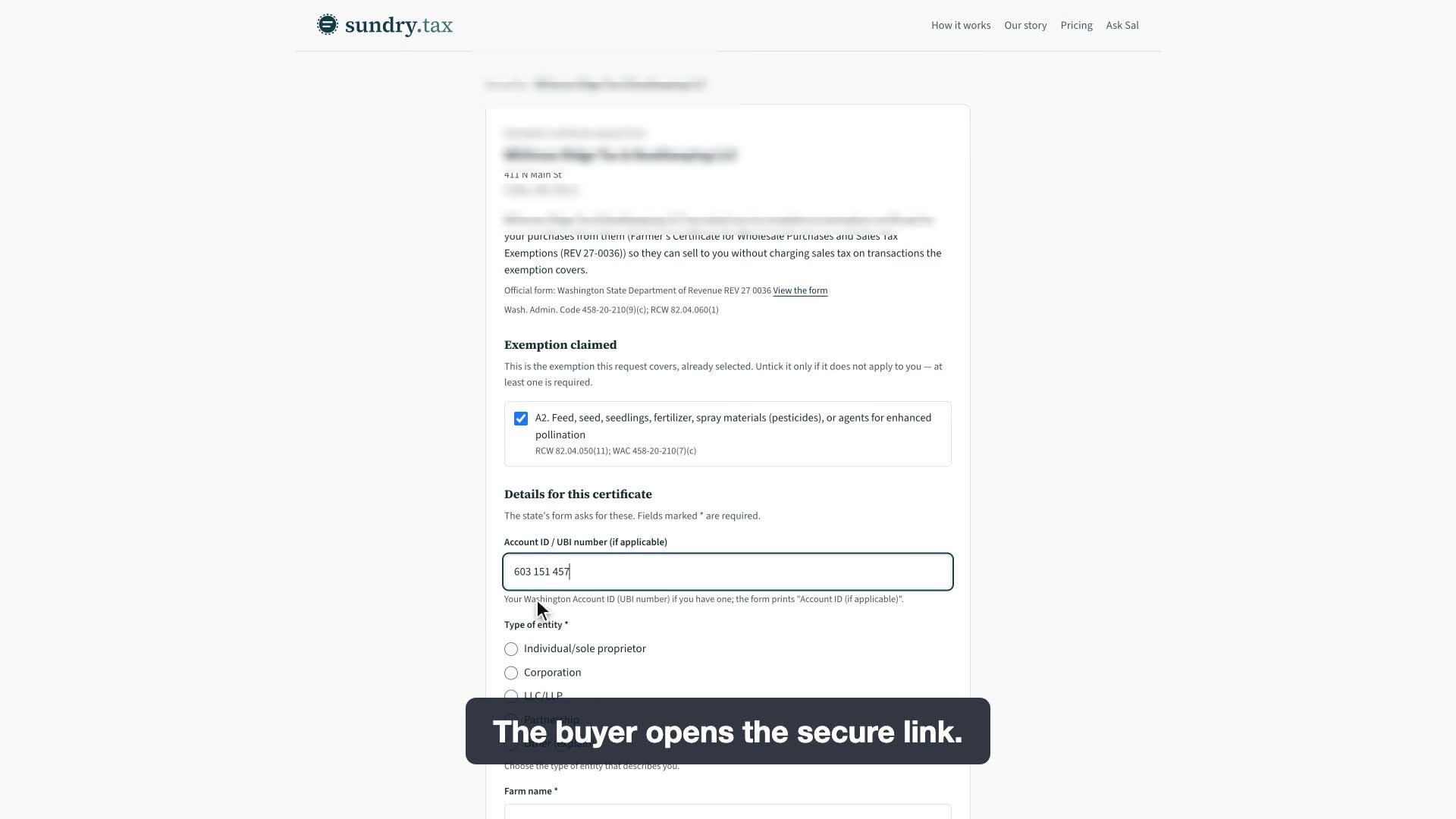
A firm asks the farmer for a signed REV 27-0036, the buyer fills in and signs it from the emailed link, and Sundry shows it signed and Verified by Sundry.
Feed, seed, seedlings, fertilizer, spray materials and pollination agents sold to a farmer for producing agricultural products for sale are not retail sales in Washington at all: they are wholesale sales, so no sales tax applies and the seller reports wholesaling B&O tax. The same goods sold for lawns, pets, riding stables or a family's own food are ordinary retail sales.
Who qualifies
- Farmers buying for the purpose of producing any agricultural product for sale.
- Farmers buying for the purpose of providing bee pollination services. Eligible apiarists are farmers and may use the form.
- Participants in the federal conservation reserve program, environmental quality incentives program, wetlands reserve program or wildlife habitat incentives program, or their USDA successor programs.
- Farmers acting under cooperative habitat development or access contracts with a 501(c)(3) organization or the Washington Department of Fish and Wildlife to produce or improve wildlife habitat on land they own or lease.
What qualifies
- "Feed": any substance used as food to sustain or improve animals, birds, fish, bees or other insects, including grains, hay and forages, mill feeds, concentrates, stock salt, sugar, pollen patties, bone meal, fish meal, oyster shell and similar substances, and food additives given for growth or weight effects.
- "Seed": the propagative portions of plants commonly used for seeding or planting, including bulbs, plants, seed-like fruits, seedlings and tubers.
- "Fertilizer": any substance containing recognized plant nutrients used for its nutrient content or to promote plant growth, including limes, gypsum and manipulated animal and vegetable manures.
- "Spray materials": substances meant to prevent, destroy, control, repel or mitigate insects, rodents, nematodes, mites, mollusks, fungus, weeds and other pests, including treated grains, plant regulators, defoliants, desiccants and spray adjuvants.
- Agents for enhanced pollination, including insects such as bees.
Not covered
- Feed sold to riding clubs, racetrack operators, boarders and similar buyers who do not resell the feed at a specific charge.
- Feed for pets or work animals, or for animals raised to produce food for the buyer's own consumption.
- Seed, fertilizer and spray materials for lawns, gardens or other personal use.
- Hormones and similar products that make no direct nutritional or energy contribution, and products used as medicines. They are not "feed."
- Seeds or propagative portions of plants used to grow cannabis.
- Farm machinery, parts, tools and cleaning materials. They are retail sales unless a specific exemption applies.
What the buyer gives
Either a copy of the buyer's reseller permit or a completed form REV 27 0036 (revision 7/13/23), Section A, "Wholesale purchases": "Feed, seed, seedlings, fertilizer, spray materials (pesticides), or agents for enhanced pollination." WAC 458-20-210(7)(a): "A seller must take and retain from the buyer a copy of the buyer's reseller permit, or a completed 'Farmers' Certificate for Wholesale Purchases and Sales Tax Exemptions' to document the wholesale nature of any transaction." The signature block asks for Account ID (if applicable), type of entity, name of buyer, farm name, mailing address, authorized signature, date, title and phone number. By signing, the buyer states it qualifies, that it "must keep records to verify the exempt nature of the sale," and that misuse "will result in taxes due, applicable interest, and possible penalties." The form has no field for the seller's name. The buyer ticks single use or blanket; a blanket certificate stays valid while there is at least one sale within 12 months. Cannabis growers and producers cannot use the form.
What the seller keeps
These are wholesale sales, so the seller reports them under wholesaling B&O tax and collects no sales tax (WAC 458-20-210(7) and (7)(c)). RCW 82.04.470(1): "The burden of proving that a sale is a wholesale sale rather than a retail sale is on the seller." Keep the reseller permit copy or the completed Section A certificate. Form REV 27 0036 says the seller "must retain the original of this certificate for their records" and must not send a copy to the Department, and: "A seller who accepts this completed certificate is relieved of the responsibility to collect retail sales or use tax unless the seller fraudulently fails to collect the tax or solicits the purchaser to participate in unlawfully claiming the exemption." The certificate does not expire while buyer and seller have at least one sale within twelve consecutive months; after a longer gap the seller must obtain a new form. WAC 458-20-210(10): "Without proper documentation, sellers are liable for payment of the retail sales tax on sales claimed as exempt." RCW 82.32.070(1) requires records to be kept for five years, and RCW 82.08.050(7)(a)-(b) gives the 90-day and 120-day windows for obtaining a fully completed certificate.
Common mistakes
- Selling horse feed tax-free to a boarding stable or riding club. The rule names these as retail sales.
- Treating a farmer's purchase for its own household as wholesale. WAC 458-20-210 Example 1: vegetable fertilizer is wholesale, but feed for hens kept for the grower's own eggs is retail.
- Putting animal health products on Section A. Medicines and hormones are not feed; FDA- or USDA-approved animal pharmaceuticals have their own line (Section B line 3).
- Dual-purpose buying. A buyer who cannot tell at purchase whether goods will be resold or consumed buys by the general nature of its business: if more than 50 percent is resold, the reseller permit may cover the whole purchase, and deferred sales tax is due on the part consumed.
Common questions
- Does a Washington farmer pay sales tax on fertilizer?
- No, if the fertilizer is used to produce an agricultural product for sale and the farmer gives the seller a reseller permit copy or a completed REV 27 0036 Section A. The sale is a wholesale sale, not a retail sale.
- Is hay sold to a horse boarding stable taxable?
- Yes. WAC 458-20-210 says sales of feed to riding clubs, racetrack operators, boarders and similar persons who do not resell the feed at a specific charge are retail sales.
- I am in a USDA conservation program but do not farm for sale. Do I qualify?
- Yes for feed, seed, seedlings, fertilizer, pollination agents and spray materials, if you participate in the conservation reserve, environmental quality incentives, wetlands reserve or wildlife habitat incentives program or a USDA successor.
- Can the farmer just give a reseller permit instead of the farmer's certificate?
- Yes. The rule allows either a copy of the buyer's reseller permit or a completed Farmers' Certificate for Wholesale Purchases and Sales Tax Exemptions.
Sources
- RCW 82.04.050 (11) not a retail sale (same text in every current and future-effective version)
- RCW 82.04.213 (1) agricultural product; (3) farmer
- WAC 458-20-210 (2)-(3); (7)(a), (7)(c)(i)-(v) and Example 1; (7)(e); (7)(g) dual purpose; (10)
- DOR form REV 27 0036 (7/13/23), Farmer's Certificate for Wholesale Purchases and Sales Tax Exemptions Page 1 Section A; page 2 signature and seller text; page 3 Section A line 2 instructions
- RCW 82.04.470 (1) seller burden for wholesale sales (fetched for the pilot)
- RCW 82.08.050 (4), (7)(a)-(c) seller records and certificate timing
- RCW 82.32.070 (1) five-year record retention
- Form
- REV 27-0036: Farmer's Certificate for Wholesale Purchases and Sales Tax Exemptions
- Statute
- RCW 82.04.050(11); WAC 458-20-210(7)(c)
- Category
- Use
- How the buyer provides it
- Signs the state form in the buyer portal