REV 27-0032
Adaptive automobile equipment bought by disabled veterans
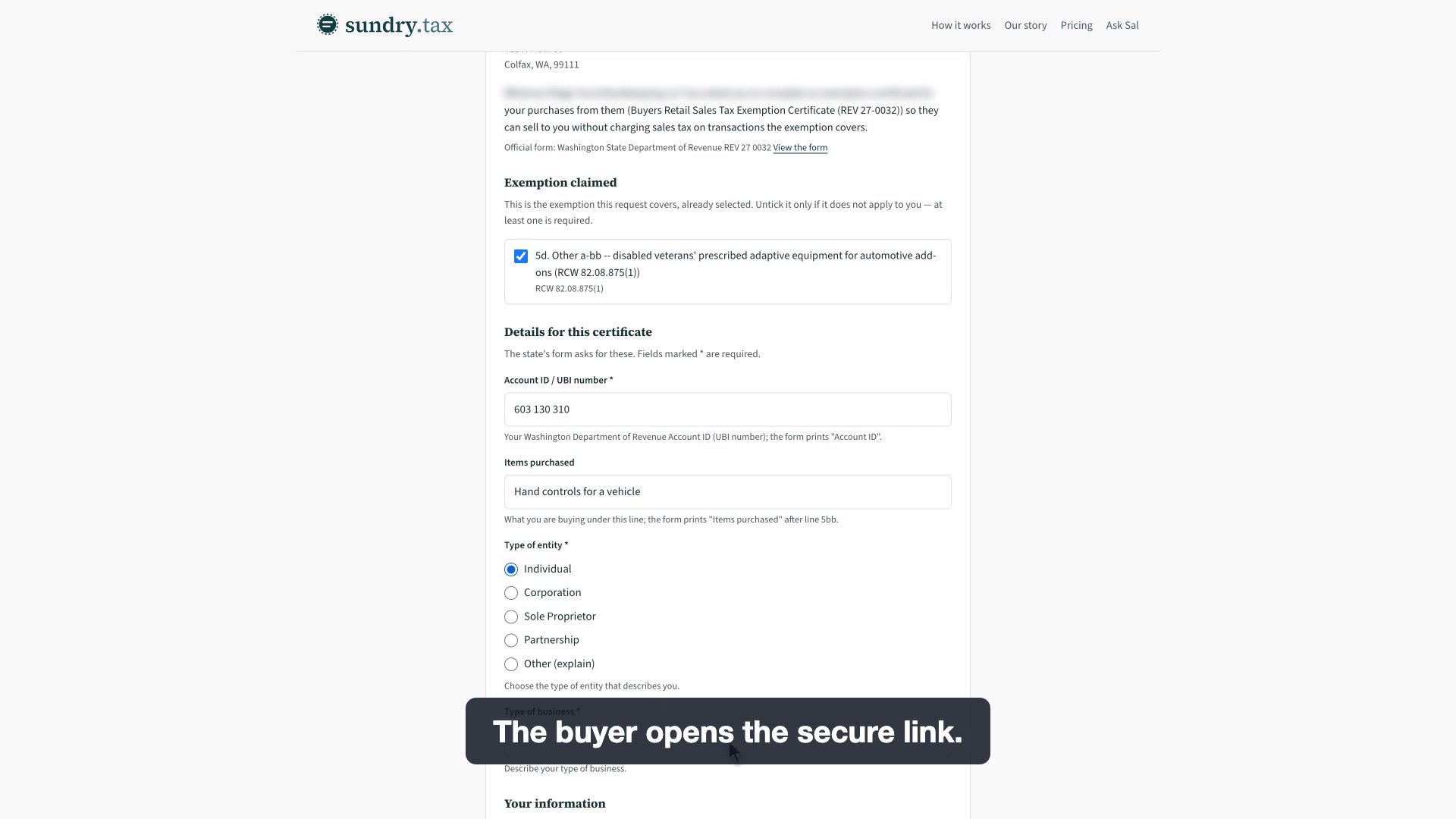
A firm asks a customer for this certificate, the buyer fills in and signs the form from the emailed link, and Sundry shows it signed and Verified by Sundry.
Disabled veterans and disabled active-duty service members pay no Washington sales or use tax on prescribed add-on adaptive equipment for their vehicles, or on installing and repairing it, when the VA or another federal agency pays the seller directly for some or all of it. The exemption expires July 1, 2028.
Who qualifies
- A veteran, or a member of the armed forces serving on active duty, who is disabled, whether or not the disability is service connected.
- Only when the purchaser is reimbursed in whole or in part by the U.S. Department of Veterans Affairs or another federal agency, and that agency pays the reimbursement directly to the seller.
What qualifies
- Add-on automotive adaptive equipment prescribed by a physician: equipment installed in, and modifications to, a vehicle that a physically challenged person needs to enter, exit or safely operate it.
- Examples in the statute: wheelchair lifts and restraints, ramps, under-vehicle lifts, power door openers, power seats, lowered floors, raised roofs and doors, hand controls, left-foot gas pedals, chest and shoulder harnesses, parking brake extensions, dual battery systems, steering devices, reduced and zero effort steering and braking, voice-activated controls and digital driving systems.
- Labor and services to install and repair that equipment.
Not covered
- The motor vehicle itself, and equipment the vehicle manufacturer installed.
- Equipment without a physician's prescription.
- Purchases where the VA or other federal agency does not pay the seller directly, for example where the buyer is reimbursed instead.
- Mobility equipment for use outside the vehicle. Mobility enhancing equipment for complex needs patients is a separate exemption (line 5bb).
- Sales on or after July 1, 2028, when the section expires.
What the buyer gives
The Buyer's Retail Sales Tax Exemption Certificate, form REV 27 0032 (6/17/25), line 5d: "Adaptive automobile equipment purchased by disabled veterans." The buyer ticks single use or blanket (blanket works while buyer and seller have at least one sale within 12 months), enters the seller's name, mailing address and the date, checks the line named below, lists the items purchased, and completes the certification block: type of entity, type of business, Account ID, buyer name and title, street address, and signature. The form says it is not for resale purchases. The form instructions repeat the conditions: prescribed by a physician, and reimbursed by the Department of Veterans Affairs with the reimbursement paid directly to the seller.
What the seller keeps
RCW 82.08.875(2): sellers must "(a) Obtain an exemption certificate from the eligible purchaser ... The seller must retain a copy of the exemption certificate for the seller's files. In lieu of an exemption certificate, a seller may capture the relevant data elements as allowed under the streamlined sales and use tax agreement; (b) File their tax return with the department electronically; and (c) Report their total gross sales on their return and deduct the exempt sales." Form REV 27 0032 says: "Seller must retain the original of this certificate for their records. Do not send a copy of this certificate to the Department of Revenue." RCW 82.32.070(1) requires taxpayers to "keep and preserve, for a period of five years, suitable records as may be necessary to determine the amount of any tax for which the taxpayer may be liable." Under RCW 82.08.050(4) a seller is not relieved of the tax unless it keeps proper records of exempt sales and provides them when asked; (7)(a) relieves a seller that obtains a fully completed certificate within 90 days after the sale, and (7)(b) allows 120 days after a department request to prove the sale was not taxable or obtain a fully completed certificate taken in good faith. RCW 82.04.470 governs reseller permits and wholesale sales; it is not the documentation rule for this exempt retail sale.
Common mistakes
- Exempting the sale when the VA reimburses the veteran rather than paying the seller. The statute requires direct payment to the seller.
- Including the base vehicle or factory-installed features.
- Filing on paper. Sellers claiming this exemption must file electronically and report gross sales before deducting.
- Assuming the disability must be service connected. It need not be.
Common questions
- Does a hand-control installation for a veteran qualify if the VA pays only part of the cost?
- Yes, if a physician prescribed it and the VA (or another federal agency) pays its share directly to the seller. The statute says reimbursed "in whole or part."
- Are repairs to a wheelchair lift exempt later?
- Yes. Labor and services for installing and repairing prescribed add-on equipment are exempt, under the same conditions.
- Does an active-duty service member qualify?
- Yes, if disabled. The statute covers a veteran or a member of the armed forces serving on active duty who is disabled.
- How long will this exemption last?
- RCW 82.08.875 and RCW 82.12.875 expire July 1, 2028.
Sources
- RCW 82.08.875 (1)-(4)
- RCW 82.12.875 (1)-(3) use tax
- DOR form REV 27 0032 (6/17/25), Buyer's Retail Sales Tax Exemption Certificate Page 1 single use/blanket; page 3 line 5d; page 6 line 5d instructions; page 4 certification and retention
- RCW 82.08.050 (4), (7)(a)-(c) seller records and certificate timing
- RCW 82.32.070 (1) five-year record retention
- RCW 82.04.470 (1), (7) reseller permits and wholesale sales
- Form
- REV 27-0032: Buyers Retail Sales Tax Exemption Certificate
- Statute
- RCW 82.08.875(1)
- Category
- Use
- How the buyer provides it
- Signs the state form in the buyer portal