REV 27-0050
Digital products used concurrently inside and outside Washington (multiple points of use)
A firm asks a customer for this certificate, the buyer fills in and signs the form from the emailed link, and Sundry shows it signed and Verified by Sundry.
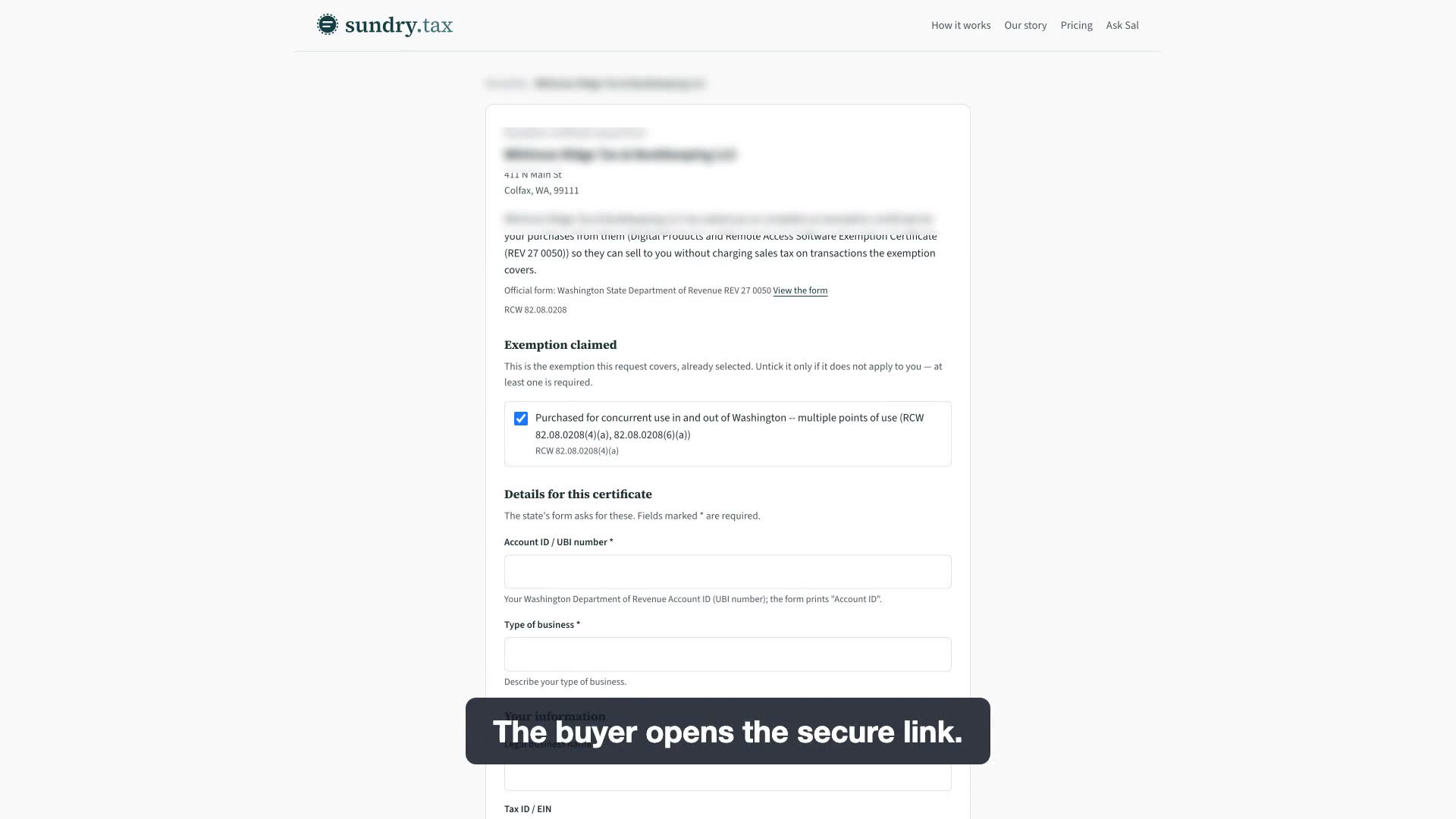
A business or organization whose staff use the same digital product or software at the same time in and outside Washington can buy it without paying sales tax, then pays Washington use tax only on the Washington share. It shifts the tax rather than removing it: the buyer reports and pays state and local use tax to the Department itself.
Who qualifies
- A business or other organization. It cannot be used for personal purchases.
- The product must be "concurrently available for use within and outside this state": the buyer's employees or other agents may use it simultaneously from at least one location in Washington and at least one location outside Washington.
What qualifies
- Digital goods, digital codes, digital automated services, prewritten computer software and remote access software. This is the widest product list of the digital exemptions, and the only exemption in section 1 of the form that covers prewritten software.
- WAC example: an online patent search service used at the same time by staff at a Washington headquarters and a California research facility.
- DOR's advertising services interim guidance says the MPU exemption applies to digital automated services, so a service that is a digital automated service may qualify if it is concurrently available in and outside Washington.
Not covered
- Products used only in Washington, or only by one location.
- Personal-use purchases.
- The Washington share. The buyer must report state and local use tax on in-state use directly to the Department.
- Bundled transactions. DOR's advertising services interim guidance says the MPU exemption is lost in a bundled transaction sold at one nonitemized price.
- A separate MPU exemption for advertising services is in RCW 82.08.0208(6); the REV 27-0050 form does not list it.
- The seller's retailing B&O tax, which still applies (DOR digital products page).
What the buyer gives
Form REV 27 0050, Digital Products and Remote Access Software Exemption Certificate (revision 11/10/25), with the "Multiple Points of Use (MPU) Exemption" box ticked. The form notes: "Buyer must report use tax for in-state use." The buyer ticks a single purchase (with the invoice or purchase order number) or a blanket certificate, valid while buyer and seller have at least one sale within twelve consecutive months; enters the seller's or marketplace facilitator's business name; gives its own business name, address, Account ID, phone, email and type of business; and signs with a printed name and date. The certification says misuse brings taxes, interest and possible penalties. The form cannot be used for purchases for personal use.
What the seller keeps
RCW 82.08.0208(4)(a): the MPU certificate "must be in a form and contain such information as required by the department." Form REV 27 0050: keep a copy and do not send it to the Department. The seller charges no sales tax on the sale and does not collect the use tax; the buyer reports it. RCW 82.32.070(1) requires taxpayers to "keep and preserve, for a period of five years, suitable records as may be necessary to determine the amount of any tax for which the taxpayer may be liable." Under RCW 82.08.050(4) a seller is not relieved of the tax unless it keeps proper records of exempt sales and provides them when the department asks; (7)(a) relieves a seller that obtains a fully completed certificate within 90 days after the sale, and (7)(b) allows 120 days after a department request to prove the sale was not taxable or obtain a fully completed certificate taken in good faith. The buyer must keep its own records: under RCW 82.12.0208(7)(c), no apportionment is allowed unless the method is supported by records kept in the ordinary course of business.
Common mistakes
- Treating MPU as tax-free. The buyer still owes Washington use tax, state and local, on the in-state share.
- Apportioning without records. The split is based on users in Washington compared with users everywhere, and must be backed by the buyer's ordinary business records.
- Claiming MPU for a team that works only in Washington. Use must be possible at the same time in and outside the state.
- Buying the product in a bundle for one unitemized price. Ask the seller to price it separately.
Common questions
- How do I calculate Washington use tax under the multiple points of use exemption?
- Divide the number of users in Washington by the number of users everywhere and apply that share to the price. WAC example: 5 of 10 users in Washington means use tax on 50 percent of the value. A "user" is an employee or agent authorized to use the product in their duties. The department may allow or require another method that fairly reflects in-state use.
- Does the MPU exemption apply to prewritten software, or only to digital products?
- Both. RCW 82.08.0208(4) covers digital goods, digital codes, digital automated services, prewritten computer software and remote access software.
- Who pays the local part of the tax?
- The buyer. It must report and pay state use tax and local use taxes directly to the Department (RCW 82.08.0208(4)(c)).
Sources
- RCW 82.08.0208 (4)(a)-(d)
- RCW 82.12.0208 (7)(a)-(d)
- WAC 458-20-15503 (507)(a)-(e), Example 30
- DOR form REV 27 0050 (11/10/25), Digital Products and Remote Access Software Exemption Certificate Section 1 MPU box; page 3 MPU requirements (1)(a)-(d)
- DOR interim guidance: changes made by ESSB 5814, advertising services Multiple points of use (MPU) exemption; bundled transactions
- DOR: Digital products including digital goods Multiple points of use
- RCW 82.08.050 (4), (7)(a)-(c) seller records and certificate timing
- RCW 82.32.070 (1) five-year record retention
- Form
- REV 27-0050: Digital Products and Remote Access Software Exemption Certificate
- Statute
- RCW 82.08.0208(4)(a)
- Category
- Use
- How the buyer provides it
- Signs the state form in the buyer portal