REV 27-0050
Digital products made available at no charge to the general public
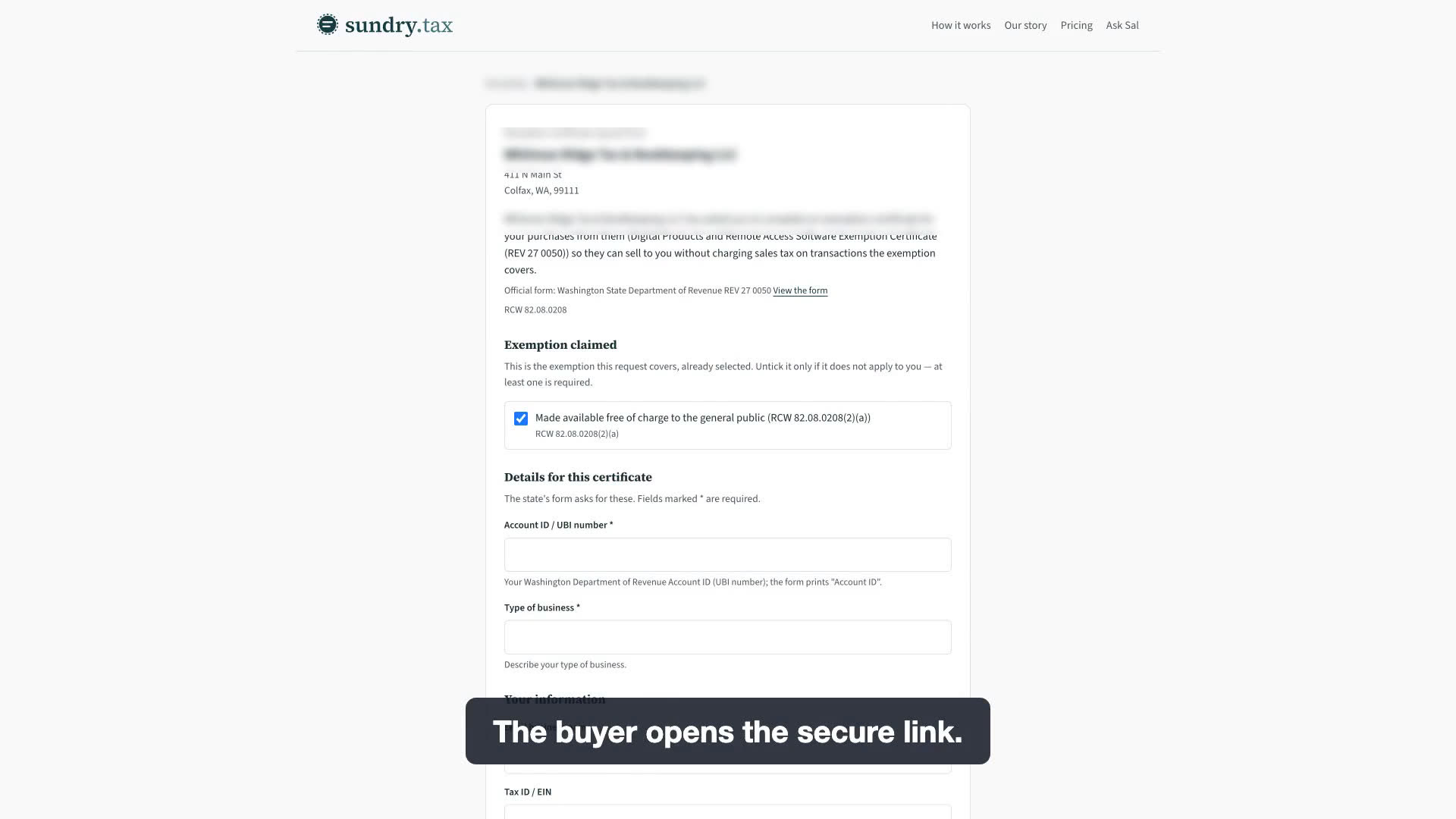
A firm asks a customer for this certificate, the buyer fills in and signs the form from the emailed link, and Sundry shows it signed and Verified by Sundry.
A business or other organization that buys digital goods, digital automated services, digital codes or remote access software in order to give them to the general public at no charge pays no Washington sales or use tax on that purchase. Two conditions do most of the work: the recipients must give nothing of significant value in return, and the buyer must hold the legal right to distribute or exhibit the product to the public.
Who qualifies
- A business or other organization, such as a company, a city or a library, that buys the product to make it available at no charge for the use or enjoyment of the general public.
- The buyer must have the legal right to broadcast, rebroadcast, transmit, retransmit, license, relicense, distribute, redistribute or exhibit the product, in whole or in part, to the general public.
- "General public" means all persons, not a restricted class, except that it also includes everyone residing or owning property within a state, political subdivision or municipal corporation, and, for libraries, authorized library patrons.
- DOR's form adds that the general public includes a group identified by minimal restrictions anyone can meet, such as a free registration requirement.
What qualifies
- Digital goods (for example music files, e-books, images, videos, data) bought to give away at no charge.
- Digital automated services and remote access software (software used on the seller's or a third party's server) made available at no charge to the public.
- Digital codes used to obtain any of these.
- WAC example: a city buys satellite images of land parcels and makes them available at no charge to residents, who enter a zip code and confirm residency. The city's purchase is exempt.
Not covered
- Giveaways that require something of significant value. WAC example: a website owner gives music files to visitors who must fill out a marketing survey that he then sells. The purchase is taxable.
- Products bought without the right to distribute or exhibit them to the public.
- Products for internal or staff use, which are not made available to the general public.
- Prewritten software sold outright; the form limits this exemption to digital goods, digital automated services, digital codes and remote access software.
- Purchases for personal use.
- The seller's retailing B&O tax, which still applies (DOR digital products page).
What the buyer gives
Form REV 27 0050, Digital Products and Remote Access Software Exemption Certificate (revision 11/10/25), with the box "Purchased to be made available free of charge to the general public" ticked. The buyer ticks a single purchase (with the invoice or purchase order number) or a blanket certificate, valid while buyer and seller have at least one sale within twelve consecutive months; enters the seller's or marketplace facilitator's business name; gives its own business name, address, Account ID, phone, email and type of business; and signs with a printed name and date. The certification says misuse brings taxes, interest and possible penalties. The form cannot be used for purchases for personal use. WAC 458-20-15503(504) requires a properly completed copy of this certificate or another certificate acceptable to the department.
What the seller keeps
RCW 82.08.0208(7): the seller "must obtain an exemption certificate from the buyer in a form and manner prescribed by the department" and "must retain a copy of the exemption certificate for the seller's files"; instead of a certificate, the seller may capture the relevant data elements allowed under the streamlined sales and use tax agreement. Form REV 27 0050: keep a copy and do not send it to the Department. RCW 82.32.070(1) requires taxpayers to "keep and preserve, for a period of five years, suitable records as may be necessary to determine the amount of any tax for which the taxpayer may be liable." Under RCW 82.08.050(4) a seller is not relieved of the tax unless it keeps proper records of exempt sales and provides them when the department asks; (7)(a) relieves a seller that obtains a fully completed certificate within 90 days after the sale, and (7)(b) allows 120 days after a department request to prove the sale was not taxable or obtain a fully completed certificate taken in good faith.
Common mistakes
- Calling a download "no charge" when visitors must hand over survey or marketing data that the buyer uses or sells.
- Buying under a license that allows only internal use, then claiming the exemption. The legal right to distribute to the public is a condition.
- Treating a members-only or customers-only offer as "general public." The statute excludes a restricted class, apart from residents of a jurisdiction and library patrons.
- Confusing this exemption with the recipient's. People who receive a digital product at no charge owe no use tax (RCW 82.12.0208(5)); the purchaser's exemption still needs a certificate.
Common questions
- Can a public library buy e-books for patrons without paying Washington sales tax?
- Yes, when the e-books are made available at no charge to authorized library patrons, who count as the general public for libraries, and the library has the right to distribute them. The library gives the seller form REV 27 0050 with the free-to-public box ticked.
- Does a free sign-up requirement disqualify a giveaway?
- Not by itself. DOR's form says the general public includes a group identified by minimal restrictions anyone can meet, such as a free registration. A sign-up that collects data of significant value in exchange is different: the WAC treats that as not free.
- Does a city qualify if only its residents can access the product?
- Yes. The statute counts everyone residing or owning property within a municipal corporation as the general public.
- Is there a limit on how many copies can be given away?
- No limit is stated. The WAC notes that most giveaways have quantity limits and that this alone does not fail the general public test.
Sources
- RCW 82.08.0208 (2)(a)-(b), (7)
- RCW 82.12.0208 (2), (5)
- WAC 458-20-15503 (202), (504)(a)-(c), Examples 27-29
- DOR form REV 27 0050 (11/10/25), Digital Products and Remote Access Software Exemption Certificate Page 1 header and section 1; pages 2-3 section 6 "Purchased to be made available free of charge to the general public"
- DOR: Digital products including digital goods Digital products given away for free
- RCW 82.08.050 (4), (7)(a)-(c) seller records and certificate timing
- RCW 82.32.070 (1) five-year record retention
- Form
- REV 27-0050: Digital Products and Remote Access Software Exemption Certificate
- Statute
- RCW 82.08.0208(2)(a)
- Category
- Use
- How the buyer provides it
- Signs the state form in the buyer portal