REV 27-0032 · REV 27-0036
Animal pharmaceuticals (not for pets)
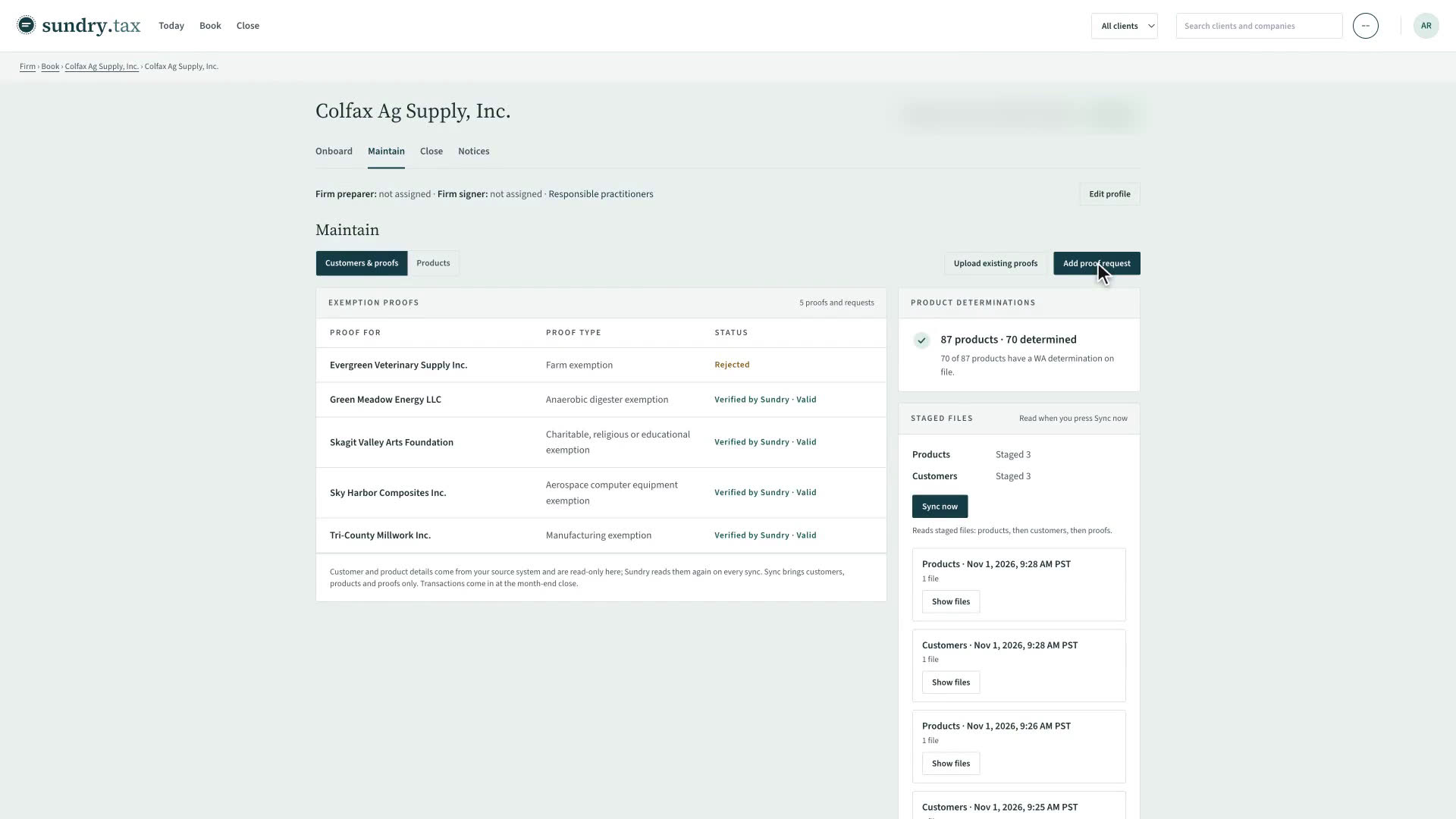
A firm asks a customer for this certificate, the buyer fills in and signs the form from the emailed link, and Sundry shows it signed and Verified by Sundry.
Buyer's certificate (REV 27-0032)
Farmer's certificate (REV 27-0036)
Farmers and licensed veterinarians pay no Washington sales or use tax on FDA- or USDA-approved animal pharmaceuticals given to animals a farmer raises to produce an agricultural product for sale. Medicines for pets, dogs and cats, and show or racing horses stay taxable.
Who qualifies
- A farmer: a person growing, raising or producing an agricultural product for sale on the person's own land or land the person has a present right to possess. Cannabis growers are not farmers.
- A veterinarian licensed to practice veterinary medicine, surgery or dentistry under chapter 18.92 RCW.
What qualifies
- Animal pharmaceuticals approved by the U.S. Department of Agriculture or the U.S. Food and Drug Administration. The rule points to the FDA "Green Book" of approved animal drugs and the USDA "Veterinary Biologics Product Catalogue"; products on neither list are not approved.
- Only when administered to an animal a farmer raises to produce an agricultural product for sale. Examples: horses, cattle or other livestock raised for sale; cattle raised for slaughter when the products are sold; dairy cows producing milk for sale; horses raised to produce foals for sale; sheep raised for wool for sale; farmed fish and shellfish raised for sale.
- A dose of an exempt pharmaceutical that comes inside the product used to give it, such as a prefilled syringe or cotton applicator.
Not covered
- Pharmaceuticals for pets, including sheep or other livestock kept as pets.
- Dogs and cats, whether pets or raised for sale. They are not agricultural products.
- Horses raised for racing, showing, riding or jumping.
- Cattle raised for slaughter when the resulting products are not sold.
- Sterilizing agents applied to equipment or facilities. They are not given to the animal.
- Teat dips, udder washes, salves and other products not on the FDA or USDA approved lists.
- Syringes and other products used to give the medicine, even if later used for an exempt pharmaceutical.
What the buyer gives
Veterinarians use the Buyer's Retail Sales Tax Exemption Certificate, form REV 27 0032 (6/17/25), line 5e ("Animal pharmaceuticals purchased by veterinarians. This exemption does not apply to pharmaceuticals for pets"), and describe the items in the space on that line. The buyer ticks single use or blanket (blanket works while buyer and seller have at least one sale within 12 months), enters the seller's name, mailing address and the date, checks the line named below, lists the items purchased, and completes the certification block: type of entity, type of business, Account ID, buyer name and title, street address, and signature. The form says it is not for resale purchases. Farmers may use the Farmer's Certificate for Wholesale Purchases and Sales Tax Exemptions, form REV 27 0036 (7/13/23), line 3 ("Animal pharmaceuticals"), signed with Account ID if any, type of entity, buyer and farm name, mailing address, title, phone and date. WAC 458-20-210(10) says farmers may use the Farmer's Certificate and must keep records to show eligibility.
What the seller keeps
RCW 82.08.880(2): "The exemption is available only when the buyer provides the seller with an exemption certificate in a form and manner prescribed by the department. The seller must retain a copy of the certificate for the seller's files." Both REV 27 0032 and REV 27 0036 say to keep the original and not send it to DOR. Form REV 27 0036 adds that the seller is relieved of collecting the tax unless it fraudulently fails to collect or solicits the buyer to claim the exemption unlawfully. In lieu of a certificate, a seller may capture the data elements allowed under the streamlined sales and use tax agreement (WAC 458-20-210(10)). RCW 82.32.070(1) requires taxpayers to "keep and preserve, for a period of five years, suitable records as may be necessary to determine the amount of any tax for which the taxpayer may be liable." Under RCW 82.08.050(4) a seller is not relieved of the tax unless it keeps proper records of exempt sales and provides them when asked; (7)(a) relieves a seller that obtains a fully completed certificate within 90 days after the sale, and (7)(b) allows 120 days after a department request to prove the sale was not taxable or obtain a fully completed certificate taken in good faith. RCW 82.04.470 governs reseller permits and wholesale sales; it is not the documentation rule for this exempt retail sale.
Common mistakes
- Selling pet medicines tax-free to a veterinary clinic. The exemption follows the animal, not the buyer: only animals raised by a farmer to produce an agricultural product for sale.
- Exempting products that are not FDA- or USDA-approved, such as many teat dips, udder washes and salves.
- Exempting syringes and applicators. Only the pharmaceutical dose inside them qualifies.
- Exempting sanitizers used on milking equipment. They are not administered to animals.
- Treating racing or show horses as farm animals. They do not qualify unless later raised to produce foals for sale.
Common questions
- Can a vet clinic buy all its drugs tax-free?
- No. Only FDA- or USDA-approved pharmaceuticals given to animals a farmer raises to produce an agricultural product for sale. Drugs for pets, dogs and cats, and racing or show horses are taxable.
- How do I tell whether a product is approved?
- WAC 458-20-210 points to the FDA Green Book of approved animal pharmaceuticals and the USDA Veterinary Biologics Product Catalogue. Products on neither list are not approved and do not qualify.
- Which certificate does a rancher use?
- A farmer may use the Farmer's Certificate, REV 27 0036, line 3. Veterinarians use the Buyer's Retail Sales Tax Exemption Certificate, REV 27 0032, line 5e.
- Is a prefilled syringe of an approved vaccine exempt?
- The dose of the exempt pharmaceutical inside it is. Syringes and other products used to give medicine are not exempt on their own.
Sources
- RCW 82.08.880 (1)-(3)
- RCW 82.12.880 (1)-(2) use tax
- WAC 458-20-210 (9)(p)(i)-(vii), (10)
- DOR form REV 27 0032 (6/17/25), Buyer's Retail Sales Tax Exemption Certificate Page 1 single use/blanket; page 3 line 5e; page 6 line 5e instructions; page 4 certification and retention
- DOR form REV 27 0036 (7/13/23), Farmer's Certificate for Wholesale Purchases and Sales Tax Exemptions Header (cannabis); line 3; page 2 signature and retention; page 3 farmer defined; page 4 line 3
- RCW 82.08.050 (4), (7)(a)-(c) seller records and certificate timing
- RCW 82.32.070 (1) five-year record retention
- RCW 82.04.470 (1), (7) reseller permits and wholesale sales
- Form
- REV 27-0032: Buyers Retail Sales Tax Exemption Certificate
REV 27-0036: Farmer's Certificate for Wholesale Purchases and Sales Tax Exemptions - Statute
- RCW 82.08.880(1); WAC 458-20-210
- Category
- Use
- How the buyer provides it
- Signs the state form in the buyer portal